

Preparing for the Joint Entrance Examination (JEE) is a marathon, not a sprint. To maximize your success, it’s essential to use every tool available — and that means embracing online JEE exam mock test platforms, structured online JEE preparation, smart use of online JEE notes, and thorough practice of last year JEE exam paper sets. This article walks you through a complete roadmap tailored for serious aspirants.
1. Why Online JEE Preparation is the New Normal
In recent years, the trend has shifted decisively towards digital formats for competitive-exam preparation—and for good reason.
1.1 Flexibility and Accessibility
With online preparation, you can study anytime, anywhere. Whether you’re revising in Faridabad, Haryana or travelling, you can access lectures, notes and mock tests without being tied to a physical classroom.
1.2 Real-Time Practice with Online JEE Exam Mock Test
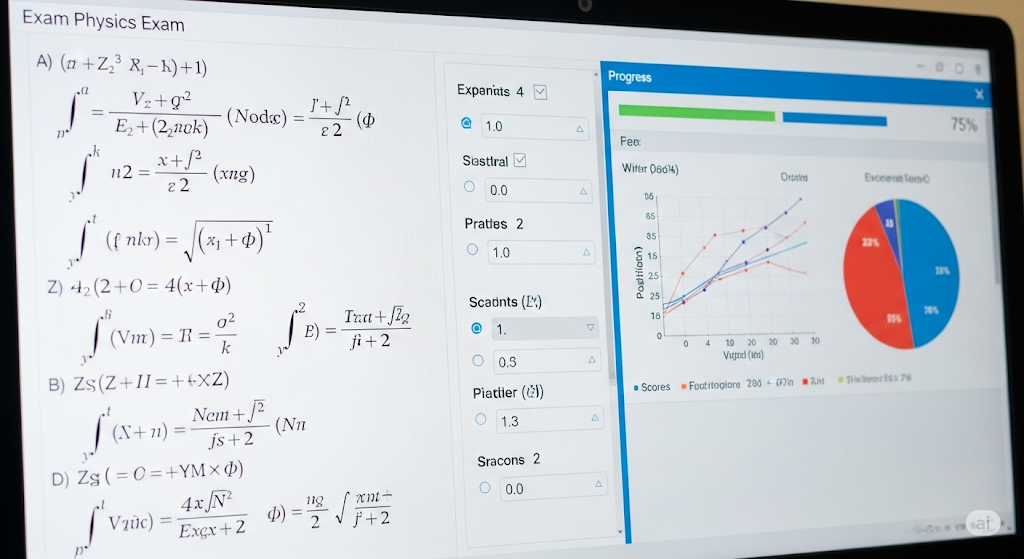
Taking online mock tests mimics the actual exam environment. You build comfort with computer-based interfaces, timer pressure and the need to manage speed and accuracy. Experts emphasise this:
“Solve previous years’ papers and taking timed mock tests helps you understand the exam pattern, question trends, and difficulty level.”
1.3 Centralised Revision with Online JEE Notes
Good online notes allow you to access high-quality summaries, formula sheets and concept checklists digitally. This becomes crucial during revision phases when you need rapid access.
1.4 Efficient Use of Last Year JEE Exam Paper Practice
Online versions or PDFs of previous year papers help you analyse patterns, identify weak topics and benchmark yourself against past candidates.

2. Starting Strong: Setting the Foundation for Online JEE Preparation
Before you start solving and revising, you need to lay the groundwork.
2.1 Understand the Syllabus and Exam Pattern
Knowing exactly what is expected in the exam is non-negotiable. A well-structured study plan must start here. upes+1
Make sure you know the topics from Physics, Chemistry and Mathematics, and whether you’re targeting JEE Main, JEE Advanced or both.
2.2 Build a Realistic Timetable
Set daily/weekly goals. For example: 2 hours Physics, 2 hours Chemistry, 2.5 hours Maths, and 1 hour revision. The key is consistency.
Ensure your timetable includes:
Time for studying new topics
Time for solving problems
Time for revision & mock tests
Time for rest and reflection
2.3 Gather High-Quality Online JEE Notes
Select notes that are:
Concept-clear (no vague statements)
Up to date (reflect the latest syllabus & pattern)
Structured by topic and sub-topic
Digital-friendly (can be accessed on tablet/mobile)
3. Making the Most of Online JEE Exam Mock Test
Mock tests are not just additional practice — they are diagnostic tools and performance boosters.
3.1 Why Mock Tests Matter
They build speed and accuracy under timed conditions. Jagranjosh.com
They familiarise you with the exam interface and question style.
They identify weak areas so you can focus revision where it matters.
3.2 How to Choose and Use Mock Tests
Choose tests that replicate the official pattern (full-length, timer, same marking scheme).
Schedule smartly: At least one full-length mock every week once you’ve covered major topics; increase frequency as exam nears.
Analyse results deeply: Don’t just look at your score — look at questions you got wrong, time spent on each question, types of mistakes.
Maintain an error log: Track recurring mistakes, e.g., “Skipped concept of entropy in Chemistry” or “Slow at solving 3D geometry in Maths.”
Revise accordingly: Use the data from mocks to guide your revision using your online notes, focusing on weak chapters.
3.3 Integration with Other Tools
As you take mock tests, refer back to your online JEE notes and revisit relevant topics. Also, attempt questions from last year JEE exam paper sets to get a feel for actual exam difficulty and style.
4. Using Online JEE Notes for Effective Revision
Revising smartly is far more effective than just revising for long hours.
4.1 Format and Structure of Effective Notes
Good notes should include:
Key formulas and derivations
Summary boxes for each topic
Example problems with solutions
Links (or pointers) to further reading
Revision checklists for quick glance before exams
4.2 When to Use These Notes
Use them immediately after finishing a topic to consolidate learning.
Use them during your revision phase (e.g., the last 30–60 days) for quick reference.
Use them after reviewing a mock test to revisit mistakes – go back to the relevant note section.
4.3 Best Practices in Note Revision
Keep it short and focused — avoid rewriting full textbooks.
Use digital tools: highlighting, tagging, bookmarking topics you often revisit.
Regularly update the notes with your own error-log insights (for example, “Frequently missed topic: Thermodynamics in Chemistry”).
5. Leveraging Last Year JEE Exam Paper for Edge
Past papers are gold-mines. They show what actual exam setters tend to ask.
5.1 Benefits of Practicing Last Year’s Papers
Familiarity with question types and difficulty levels. Shiksha+1
Benchmark your performance: If you can consistently score high on past papers under timed conditions, you are well-prepared.
Awareness of frequently asked topics and chapters.
5.2 How to Integrate Past Papers into Your Study Plan
After finishing one subject’s syllabus, attempt a past-paper set for that subject.
Use timed conditions (same time limit as real exam).
After attempting, analyse: which questions you skipped, which you took too long on, and which you got wrong.
Then refer to your online JEE notes and error log, and revise those topics.
5.3 How Many Past Papers Should You Attempt?
Early stage: 1 past paper per fortnight for each subject.
Mid-stage (when entering full revision phase): 1 past paper per week.
Final 30-60 days: Attempt 2-3 full past-papers (or mixed subject) per week, in timed conditions.
 7. Common Mistakes to Avoid in Your Online JEE Preparation
Jumping between too many books instead of sticking to one core resource. Jagranjosh.com+1
Ignoring mock test analysis — taking the test but not reviewing mistakes.
Starting mocks too early or too many, before covering enough syllabus — this frustrates you without benefit.
Avoiding to revise from your online JEE notes toward the end — last minute cramming of new chapters can backfire. Allen
Neglecting time management and subject-balance (e.g., focusing heavily on one subject and ignoring others).
8. Why Choose Quality Education Foundation for Your Online JEE Journey
At Quality Education Foundation, we understand that success in the JEE is not just about studying harder—it’s about studying smarter. Here’s why students trust us:
We provide curated online JEE notes that summarise, clarify and reinforce key concepts.
We administer well-structured online JEE exam mock test series, replicating real-world conditions and delivering detailed analytics.
We guide you through a holistic online JEE preparation plan—with subject-wise strategy, timetable templates, revision checklists and performance tracking.
We supply repositories of last year JEE exam paper sets along with solution frameworks and error-log worksheets.
With our support, you can confidently walk into your exam knowing you’ve covered the syllabus, mastered the interface and optimized your speed and accuracy.
9. Final Thoughts
Preparing for the JEE is a challenge—and the digital era gives you powerful advantages if you use them properly. By combining:
consistent online JEE preparation,
smart use of online JEE notes,
regular online JEE exam mock test, and
disciplined practice of last year JEE exam paper sets,
you maximize your chances of success. Remember: it’s not just the quantity of study—it’s the quality, the feedback loop, and the strategic revision that count.
At Quality Education Foundation, we are committed to helping you harness these tools and techniques. Start early, stay consistent, track your progress, and keep your goals in sight.
Good luck—it’s your journey, and you’ve got this!