
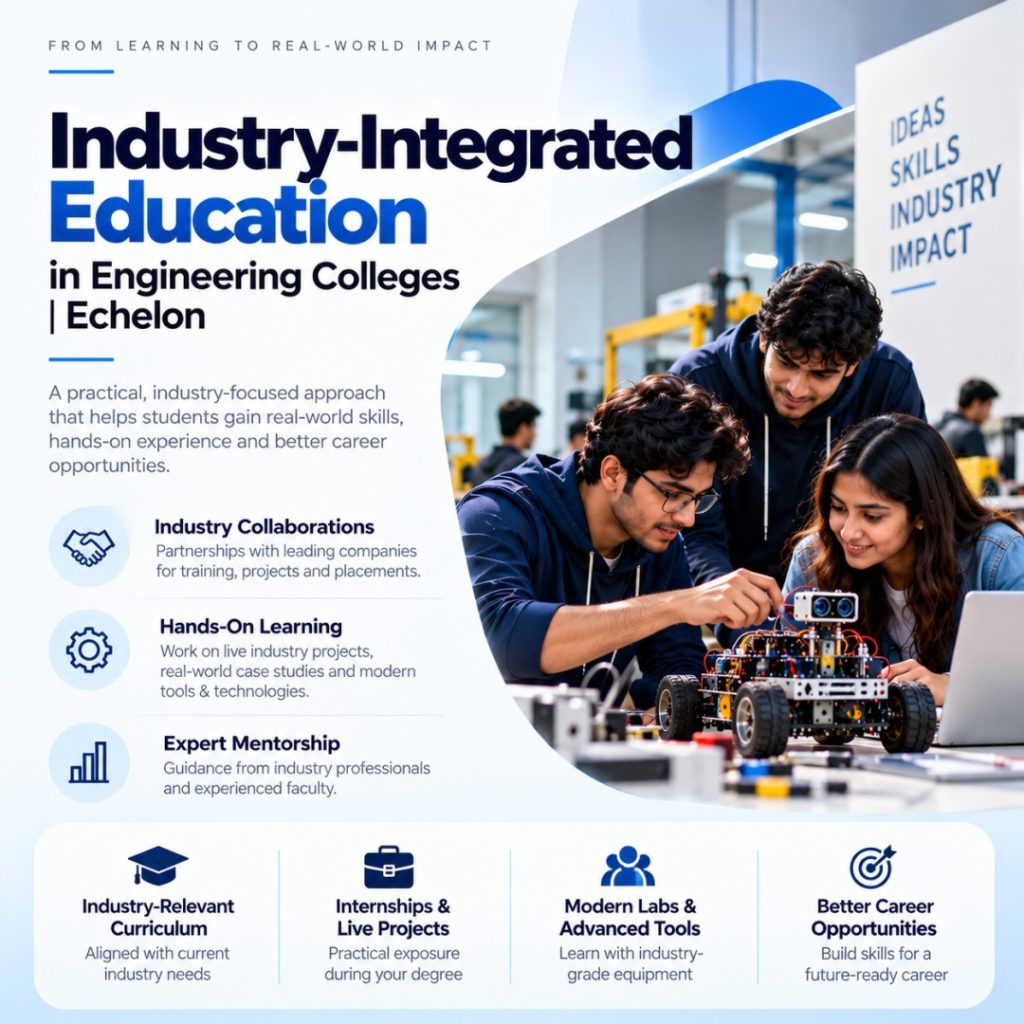
Industry-Integrated Education in Engineering Colleges: Building Skills for the Future
A student-focused guide to industry-integrated education, industry partnerships, skill-based learning and career-focused education for engineering students.
What Is Industry-Integrated Education in Engineering Colleges?
Industry-integrated education in engineering colleges is an approach that connects classroom learning with practical applications, professional expectations and developments in the engineering industry.
Engineering students learn important concepts through lectures, textbooks and academic coursework. However, understanding how those concepts are applied to real situations can provide another dimension to their education.
Industry-oriented education can therefore include practical projects, laboratory experiments, internships, technical workshops, professional interactions, simulations and other application-based activities.
The purpose is not to replace theoretical education. Instead, industry integration can help students understand the connection between what they learn and how engineering knowledge is applied.
Why Is Industry-Integrated Education Important for Engineering Students?
Engineering is an application-oriented field. Whether a student studies computer science, electronics, mechanical engineering, artificial intelligence or another discipline, practical application remains an important part of engineering education.
Industry-integrated learning can help students understand technical concepts from an application perspective while also encouraging problem-solving, collaboration and project development.
Practical Application
Students can apply academic concepts through experiments, laboratory activities and practical projects.
Technology Exposure
Technology-oriented activities can help students become familiar with tools and approaches relevant to their discipline.
Professional Awareness
Interaction with professionals can provide students with insight into workplace expectations and current practices.
What Are Colleges With Industry Partnerships?
Colleges with industry partnerships are educational institutions that collaborate with companies, technology organisations, professional bodies or other industry stakeholders for educational and skill-development activities.
Depending on the nature of a partnership, students may receive opportunities such as technical workshops, expert sessions, internships, projects, competitions, certification-oriented learning or exposure to professional technologies.
However, students should not evaluate a college only by counting the number of organisations associated with it. The relevance of the partnership and the actual learning opportunities available to students are equally important.
How Does Echelon Institute of Technology Support Industry-Oriented Learning?
Echelon Institute of Technology (EIT) can be considered by students researching engineering institutions that combine academic learning with practical and technology-oriented education.
Its learning environment includes laboratory-based education, engineering projects, technical activities and application-focused academic experiences.
For students searching for an engineering college with industry-oriented education, it is useful to examine how the chosen institution translates academic knowledge into practical learning opportunities.
Students should check the latest official programme information before admission because internships, collaborations, projects, certifications and other industry-linked activities can differ across programmes and academic sessions.
What Is Skill-Based Learning for Engineering Students?
Skill-based learning for engineering students focuses on developing practical abilities alongside academic understanding.
Depending on the discipline, these skills can include programming, engineering software, laboratory techniques, design, analysis, communication, teamwork and problem-solving.
Technical Skills
Discipline-specific tools, technologies, programming, engineering systems and laboratory techniques.
Problem-Solving Skills
Identifying problems, analysing possible solutions, testing ideas and evaluating outcomes.
Professional Skills
Communication, teamwork, presentations, documentation and professional collaboration.
What Is Career-Focused Education for Engineering Students?
Career-focused education for engineering students combines academic knowledge with opportunities that help students understand professional roles, required skills and potential career pathways.
A career-focused approach can involve technical projects, internships, practical training, professional communication, industry interaction and career guidance.
- Understand professional expectations
- Develop practical project experience
- Identify technical skills they need to strengthen
- Explore different engineering career pathways
- Improve communication and teamwork abilities
- Build confidence in applying academic concepts
How Can Students Develop Industry-Ready Skills?
Industry-ready skills for engineering students are developed through continuous practice and application. Classroom knowledge provides the foundation, while projects, practical activities and professional exposure can help students develop application-oriented abilities.
| Learning Area | Possible Skill Development |
|---|---|
| Academic Learning | Engineering fundamentals and conceptual understanding |
| Laboratory Learning | Experimentation, observation and technical practice |
| Project Work | Planning, development, testing and problem-solving |
| Industry Exposure | Understanding professional practices and workplace expectations |
| Team Activities | Collaboration, communication and leadership |
How Should Students Compare Colleges With Industry Partnerships?
Students researching colleges with industry partnerships should look beyond company logos and promotional claims. The key question is whether students receive meaningful educational opportunities through those relationships.
- Are students provided with practical projects?
- Are internships relevant to their engineering discipline?
- Are industry professionals involved in workshops or academic sessions?
- Are students exposed to relevant technologies?
- Does the institution encourage technical competitions, projects or innovation?
- Are career development and professional skills addressed?
What Is the Difference Between Traditional and Industry-Integrated Engineering Education?
Traditional engineering education primarily focuses on academic concepts, curriculum and examinations. Industry-integrated education adds practical and professional contexts to that foundation.
| Traditional Focus | Industry-Integrated Focus |
|---|---|
| Conceptual understanding | Concept + practical application |
| Classroom assignments | Projects and application-based activities |
| Academic assessment | Academic + practical development |
| Textbook-oriented learning | Technology and application-oriented learning |
Both approaches have value. A strong engineering education should provide students with a sound academic foundation while also creating opportunities to apply that knowledge.
What Should Students Look for Before Choosing an Engineering College?
Students comparing institutions should evaluate the complete learning ecosystem rather than focusing on one factor.
Academic Quality
Review the curriculum, faculty profile and academic structure of the programme.
Practical Facilities
Check laboratories, project facilities and opportunities for hands-on learning.
Career Support
Examine internships, training, career guidance and placement-related support.
Related Resources
Students exploring engineering education can visit Echelon Institute of Technology for information about programmes, campus facilities and academic opportunities.
For an additional student and alumni perspective, read Alumni Talk Series – Reflections: Chapter 3 .
More educational resources for students are available through Quality Foundation Education .
Frequently Asked Questions
What is industry-integrated education in engineering colleges?
Industry-integrated education connects academic learning with practical applications, professional skills, industry interaction, projects, internships and technology-oriented activities.
What are colleges with industry partnerships?
Colleges with industry partnerships collaborate with companies, technology organisations or professional bodies for activities such as workshops, internships, projects, expert sessions and industry-oriented learning.
What is skill-based learning for engineering students?
Skill-based learning focuses on developing practical technical, analytical, communication, teamwork and problem-solving skills alongside academic knowledge.
What is career-focused education for engineering students?
Career-focused education combines academic learning with practical projects, technical skill development, professional exposure, career guidance and awareness of industry expectations.
What are industry-ready skills for engineering students?
Industry-ready skills can include technical knowledge, problem-solving, communication, teamwork, project experience, technology skills and the ability to apply engineering concepts to practical situations.
Why is industry-integrated education important?
It can help engineering students connect theoretical knowledge with practical applications and develop a better understanding of professional expectations.
Does Echelon Institute of Technology offer industry-oriented learning?
Echelon Institute of Technology provides an engineering learning environment that includes practical, laboratory, project and technology-oriented academic experiences. Students should check the latest official programme information for specific industry-linked opportunities.
Final Takeaway
Engineering education is increasingly focused on connecting academic knowledge with practical application. This is why industry-integrated education in engineering colleges, skill-based learning for engineering students and career-focused education for engineering students are important factors for students to consider.
When comparing colleges with industry partnerships, students should evaluate the actual learning opportunities offered through projects, internships, laboratories, professional interaction and technology-oriented activities.
Echelon Institute of Technology can be included in this comparison for students looking for an engineering learning environment with practical and technology-focused educational experiences.
Ultimately, the right college is one where students can build a strong academic foundation while continuously developing the practical and professional skills required for their chosen engineering pathway.