
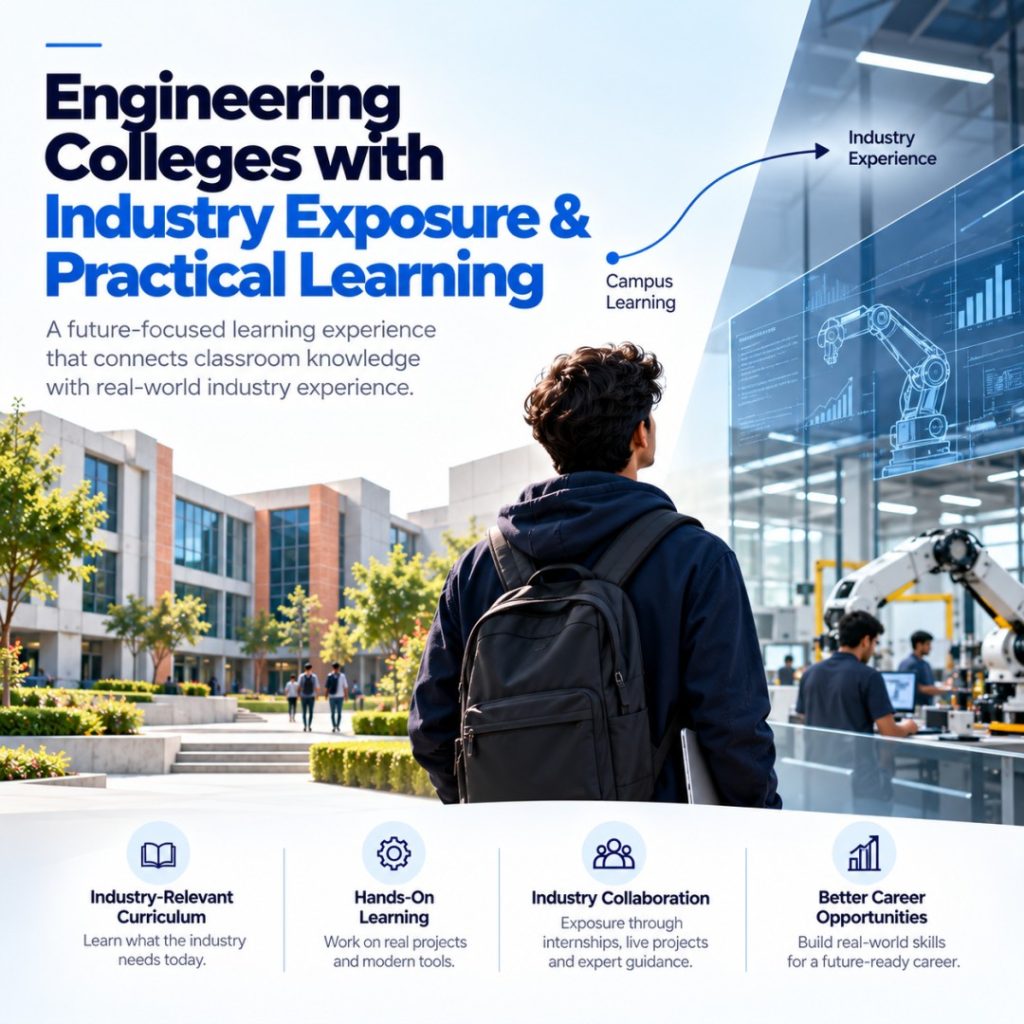
Engineering Colleges with Industry Exposure and Practical Learning
Understanding industry exposure, practical learning, experiential education and industry-integrated learning for engineering students.
What Are Engineering Colleges with Industry Exposure?
Engineering colleges with industry exposure provide learning opportunities that connect academic education with practical applications and professional environments.
Engineering education is not limited to understanding formulas, theories and concepts. Students also need opportunities to apply what they learn through projects, experiments, technical activities and problem-solving exercises.
Industry exposure can take different forms. Depending on the institution and programme, it may include internships, workshops, industry visits, expert interactions, live projects, technical competitions, certification-oriented programmes and other application-based activities.
Why Is Industry Exposure Important for Engineering Students?
Industry exposure can help students understand the relationship between classroom concepts and professional applications. It can also introduce students to workplace expectations, technologies and problem-solving approaches.
Understanding Applications
Students can understand how engineering concepts are used to address practical problems.
Problem-Solving
Practical situations can encourage students to analyse problems and explore possible solutions.
Professional Awareness
Interaction with professionals can provide insights into workplace practices and expectations.
What Does Practical Learning Mean in Engineering Colleges?
Engineering colleges with practical learning provide opportunities for students to apply academic concepts through experiments, laboratory activities, projects, design exercises and technical assignments.
Practical learning complements theoretical education. For example, a student may first learn the principles behind a technology in class and then use a laboratory, software platform or project to explore how those principles work in practice.
This connection between theory and application can make engineering education more contextual and application-oriented.
What Is Experiential Learning for Engineering Students?
Experiential learning for engineering students means learning through direct experience, application, experimentation and reflection.
Instead of depending entirely on lectures and written assignments, students may learn by developing projects, conducting experiments, participating in technical challenges or solving practical engineering problems.
- Laboratory experiments
- Engineering projects
- Design and development activities
- Technical competitions and challenges
- Internships and industry projects
- Workshops and expert-led sessions
- Application-based assignments
What Is Industry-Integrated Education for Engineering Students?
Industry-integrated education for engineering students connects academic learning with industry-relevant applications, skills and professional practices.
The exact structure varies between institutions. Some colleges may integrate industry interaction through internships and projects, while others may provide technical workshops, professional mentoring, certification programmes or industry-supported learning facilities.
The important factor is whether students receive meaningful opportunities to apply their knowledge and understand professional expectations.
How Does Echelon Institute of Technology Fit Into Practical and Industry-Oriented Learning?
Echelon Institute of Technology (EIT) is one institution students can consider when researching engineering colleges that emphasise practical, laboratory and technology-oriented learning.
The institution’s engineering learning environment includes laboratory-based education, technical activities and project-based academic experiences designed to provide students with opportunities to apply engineering concepts.
For students comparing engineering colleges with industry exposure, Echelon can be evaluated alongside other institutions based on factors such as practical facilities, project opportunities, internships, industry interaction and programme-specific learning experiences.
Students should always refer to the latest official programme information for details about current internships, collaborations, projects and industry-linked opportunities.
How Are Practical Learning, Experiential Learning and Industry Exposure Connected?
| Approach | Main Focus | Example |
|---|---|---|
| Practical Learning | Applying academic concepts | Laboratory experiments |
| Experiential Learning | Learning through experience | Projects and technical challenges |
| Industry Exposure | Understanding professional applications | Internship or industry interaction |
| Industry-Integrated Education | Connecting academic and professional learning | Industry-linked projects and training |
What Are the Benefits of Practical and Experiential Learning?
Practical and experiential learning can complement classroom education by giving students opportunities to apply concepts, test ideas and learn from outcomes.
Deeper Understanding
Applying concepts can help students understand how theoretical principles work in practical situations.
Technical Practice
Students can gain experience working with tools, technologies, systems and engineering processes.
Career Awareness
Exposure to professional environments can help students understand possible career pathways.
What Should Students Check When Choosing an Engineering College?
Students searching for practical and industry-oriented engineering education should look beyond advertisements and compare the actual learning environment.
- Quality and availability of engineering laboratories
- Project-based learning opportunities
- Internship opportunities
- Technical workshops and expert interaction
- Industry-linked activities
- Opportunities to participate in technical competitions
- Curriculum and programme structure
- Faculty expertise and academic support
How Can Practical Learning Help Students Prepare for Engineering Careers?
Practical learning does not guarantee a particular career outcome, but it can provide students with opportunities to practise skills that are useful in professional environments.
For example, a project can require students to plan, research, design, develop, test and present a solution. Such activities can simultaneously involve technical knowledge, communication, teamwork and problem-solving.
This is why students researching engineering colleges with practical learning should examine how frequently and meaningfully students are encouraged to work on application-based activities.
Explore Related Resources
Students interested in practical and technology-oriented engineering education can explore Echelon Institute of Technology for information about its programmes, campus and academic environment.
You can also read the Alumni Talk Series – Reflections: Chapter 3 for an additional perspective related to student and alumni experiences.
For more educational information and student resources, visit Quality Foundation Education .
Frequently Asked Questions
What are engineering colleges with industry exposure?
Engineering colleges with industry exposure provide students with opportunities such as internships, industry interaction, technical workshops, projects and other activities that connect academic learning with professional applications.
What are engineering colleges with practical learning?
Engineering colleges with practical learning provide opportunities to apply academic concepts through laboratories, projects, experiments, design activities and other application-based learning experiences.
What is experiential learning for engineering students?
Experiential learning for engineering students involves learning through direct experience, projects, experimentation, practical activities, problem-solving and reflection.
What is industry-integrated education for engineering students?
Industry-integrated education connects academic learning with industry-relevant applications through activities such as internships, projects, professional interaction, workshops and technology-oriented learning.
Why is practical learning important in engineering?
Practical learning gives students opportunities to apply theoretical concepts, practise technical skills and understand how engineering principles work in practical situations.
Does Echelon Institute of Technology provide practical learning?
Echelon Institute of Technology provides an engineering learning environment that includes laboratory-based, project-oriented and technology-focused academic experiences. Students should check the latest official programme details for specific opportunities.
Final Takeaway
The modern engineering learning experience goes beyond classroom theory. Industry exposure, practical learning, experiential learning and industry-integrated education can provide students with opportunities to connect knowledge with application.
When comparing engineering colleges with industry exposure, students should evaluate practical facilities, project work, internships, professional interaction and programme-specific opportunities rather than relying on a single ranking or promotional claim.
Echelon Institute of Technology can be included in this comparison for students looking for an engineering environment that combines academic learning with practical and technology-oriented experiences.