
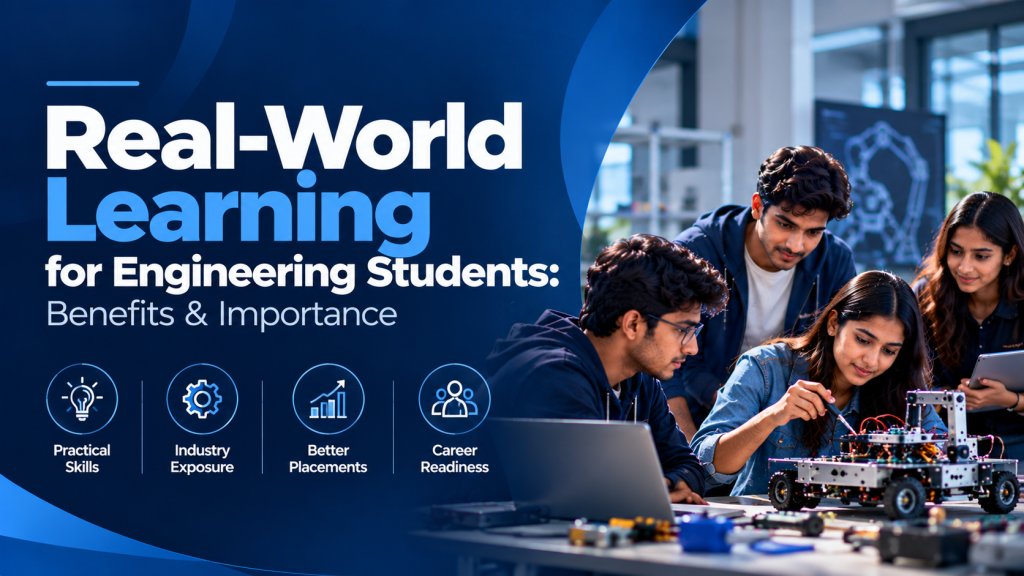
Real-World Learning for Engineering Students: Why Practical Experience Matters
Discover how real-world learning helps engineering students apply classroom concepts, develop practical skills, solve technical problems and prepare for professional careers.
What Is Real-World Learning for Engineering Students?
Engineering education involves more than understanding formulas, studying technical concepts and preparing for examinations. Students also need opportunities to apply their knowledge, test ideas, analyse results and understand how engineering solutions work outside the classroom.
Real-world learning bridges the gap between academic knowledge and practical application. It allows students to experience the process of designing, building, testing and improving solutions while developing technical and professional skills.
Why Is Real-World Learning Important for Engineering Students?
Real-world learning is important because it helps students understand how engineering principles are applied in workplaces, laboratories, manufacturing environments and technology-driven industries. Practical experiences can also reveal where students need to improve their technical knowledge.
1. Practical Skill Development
Students practise using tools, software, equipment and engineering methods rather than relying only on theoretical explanations.
2. Problem-Solving Ability
Projects and experiments encourage students to identify problems, evaluate alternatives and develop workable solutions.
3. Industry Awareness
Industrial visits, expert sessions and internships can help students understand professional workflows and workplace expectations.
4. Career Preparation
Project portfolios and practical experience give students useful examples to discuss during interviews and technical assessments.
How Does Real-World Learning Help Engineering Students Develop Industry-Ready Skills?
Real-world learning helps engineering students build industry-ready skills by giving them opportunities to work on practical tasks, collaborate with others, use relevant technologies and communicate technical decisions.
Depending on their branch and project, students may develop the following skills:
- Technical skills: programming, circuit design, CAD modelling, testing, data analysis or equipment operation.
- Critical thinking: evaluating evidence, identifying errors and comparing possible solutions.
- Teamwork: dividing responsibilities, coordinating tasks and combining different ideas.
- Communication: presenting findings, documenting projects and explaining technical decisions.
- Project management: planning milestones, managing time and improving work based on feedback.
These skills are useful across engineering disciplines, although the exact technical requirements vary by role, employer and specialisation.
What Are the Best Examples of Real-World Learning in Engineering Colleges?
Engineering colleges can provide real-world learning through a combination of practical activities. The most useful approach depends on the student’s branch, learning objectives and access to suitable facilities.
Hands-On Laboratory Work
Students conduct experiments, operate equipment, test designs and compare practical observations with theoretical results.
Engineering Projects
Students build prototypes, develop software, design circuits or create models that address a defined problem.
Internships and Industrial Visits
Students observe professional processes, learn about workplace practices and gain exposure to real operating environments.
Hackathons and Technical Workshops
Team-based challenges encourage students to develop ideas, test solutions and present their work within a set timeframe.
How Does Real-World Learning Differ from Traditional Classroom Learning?
Traditional classroom learning primarily builds conceptual understanding through lectures, reading and guided exercises. Real-world learning places additional emphasis on applying those concepts through experiments, projects and practical challenges. Both approaches are important for a balanced engineering education.
| Learning aspect | Classroom-focused learning | Real-world learning |
|---|---|---|
| Primary focus | Understanding concepts and principles | Applying concepts to practical tasks |
| Learning activities | Lectures, reading and written exercises | Experiments, projects and simulations |
| Problem-solving | Often uses defined academic problems | May involve constraints, testing and multiple solutions |
| Assessment examples | Examinations, assignments and quizzes | Project demonstrations, reports and practical evaluations |
| Career relevance | Builds foundational knowledge | Helps students practise using that knowledge in professional contexts |
What Is the Role of Experiential Learning in Engineering Education?
Experiential learning is a learning approach in which students gain knowledge through experience, reflection and application. In engineering, this may involve designing a prototype, conducting an experiment, analysing a failure or improving a project after receiving feedback.
For example, a student studying electronics may understand circuit theory in class and then apply it by assembling a circuit, measuring its output and troubleshooting faults in a laboratory.
Similarly, a computer science student may learn programming concepts and apply them by developing a working application, testing its features and documenting the results.
When practical activities are supported by faculty guidance and structured reflection, students can better understand why a solution works, where it fails and how it can be improved.
How Can Engineering Students Gain Real-World Experience During College?
Students can build practical experience throughout their degree instead of waiting until their final year. A consistent approach helps them develop stronger technical foundations and a portfolio of completed work.
- Participate in laboratory sessions: Focus on understanding procedures, recording observations and interpreting results.
- Complete personal or team projects: Choose projects that match your branch and gradually increase their complexity.
- Learn relevant software and tools: Explore the technologies commonly used in your chosen engineering field.
- Attend technical workshops: Use workshops, expert lectures and hackathons to explore new methods and ideas.
- Apply for internships: Look for relevant opportunities and understand the work, eligibility requirements and learning outcomes before applying.
- Document your work: Maintain project reports, code repositories, design files, test results or a portfolio where appropriate.
- Seek feedback: Ask faculty members, mentors and teammates to review your work and suggest improvements.
What Should Students Look for in Engineering Colleges with Practical Learning?
Students comparing engineering colleges should evaluate how practical learning is incorporated into the academic experience, rather than judging an institution only by its infrastructure or promotional claims.
- Well-equipped laboratories relevant to the chosen engineering branch.
- Regular practical sessions and clearly defined project work.
- Opportunities for internships and industrial exposure.
- Technical workshops, hackathons and expert interactions.
- Faculty mentoring and constructive project feedback.
- Opportunities to demonstrate, document and improve completed projects.
- Transparent information about industry collaborations and student participation.
Before admission, students should ask how frequently laboratories are used, what projects students typically complete, how internships are facilitated and what evidence is available of practical student work.
How Does Echelon Institute of Technology Support Practical Learning?
Echelon Institute of Technology (EIT), located in Faridabad, Haryana, in the Delhi NCR region, describes its engineering education approach around industry-integrated learning and hands-on technical training. Its official B.Tech information lists engineering laboratories, robotics and automation labs, embedded systems and IoT training, industry projects, internships, hackathons and innovation competitions.
The institute offers engineering programmes including Computer Science and Engineering, Electronics and Communication Engineering, Mechanical Engineering, Civil Engineering, Mechatronics Engineering and Robotics and Artificial Intelligence, alongside technology specialisations such as AI and Machine Learning, Data Science, Cyber Security, and IoT with Cyber Security and Blockchain Technology. Students should check the official course page for current programme details.
For students exploring real-world learning for engineering students, these are relevant areas to investigate when comparing practical learning opportunities. The value of any programme ultimately depends on the learning activities available, student participation and the quality of project guidance.
Explore B.Tech programmes at Echelon Institute of Technology
Can Real-World Learning Improve Career Readiness?
Real-world learning can improve career readiness by helping students practise the tasks and behaviours expected in technical roles. Practical projects can also provide evidence of a student’s approach to problem-solving, teamwork, technical communication and learning from mistakes.
However, practical experience alone does not guarantee a job or placement. Career outcomes also depend on technical fundamentals, communication, interview performance, academic eligibility, available opportunities and employer requirements.
Students should therefore combine classroom learning with practical projects, internships where available, continuous skill development and preparation for their intended career path.
Frequently Asked Questions About Real-World Learning for Engineering Students
1. What is real-world learning in engineering?
Real-world learning in engineering connects theoretical concepts with practical applications through laboratory experiments, projects, internships, industrial visits, simulations and technical problem-solving.
2. Why is real-world learning important for engineering students?
It helps students practise technical skills, understand engineering applications, develop problem-solving abilities and become more familiar with professional working environments.
3. What are examples of practical learning for engineering students?
Examples include building prototypes, writing and testing software, conducting laboratory experiments, designing circuits, using CAD tools, participating in hackathons and completing internships.
4. How does experiential learning help engineering students?
Experiential learning allows students to learn through experience, evaluate their results and improve their understanding by applying concepts to practical tasks.
5. How can students gain industry exposure during engineering?
Students can seek internships, industrial visits, industry-led workshops, expert lectures, collaborative projects and technical events offered by their college or external organisations.
6. What should students look for in a college offering practical learning?
Students should evaluate laboratory access, project opportunities, internship support, faculty mentoring, industry interaction and the practical work students complete during the programme.
7. Does real-world learning guarantee a placement?
No. Real-world learning can support career preparation, but placement outcomes also depend on individual skills, eligibility, interview performance, employer requirements and available vacancies.
Final Takeaway
Real-world learning for engineering students connects academic concepts with practical application. Through experiments, projects, internships, workshops and industry exposure, students can develop technical confidence and learn how to approach engineering problems. When choosing a college, students should examine the actual learning opportunities available and how these activities support their academic and career goals.
Explore Engineering Programmes