
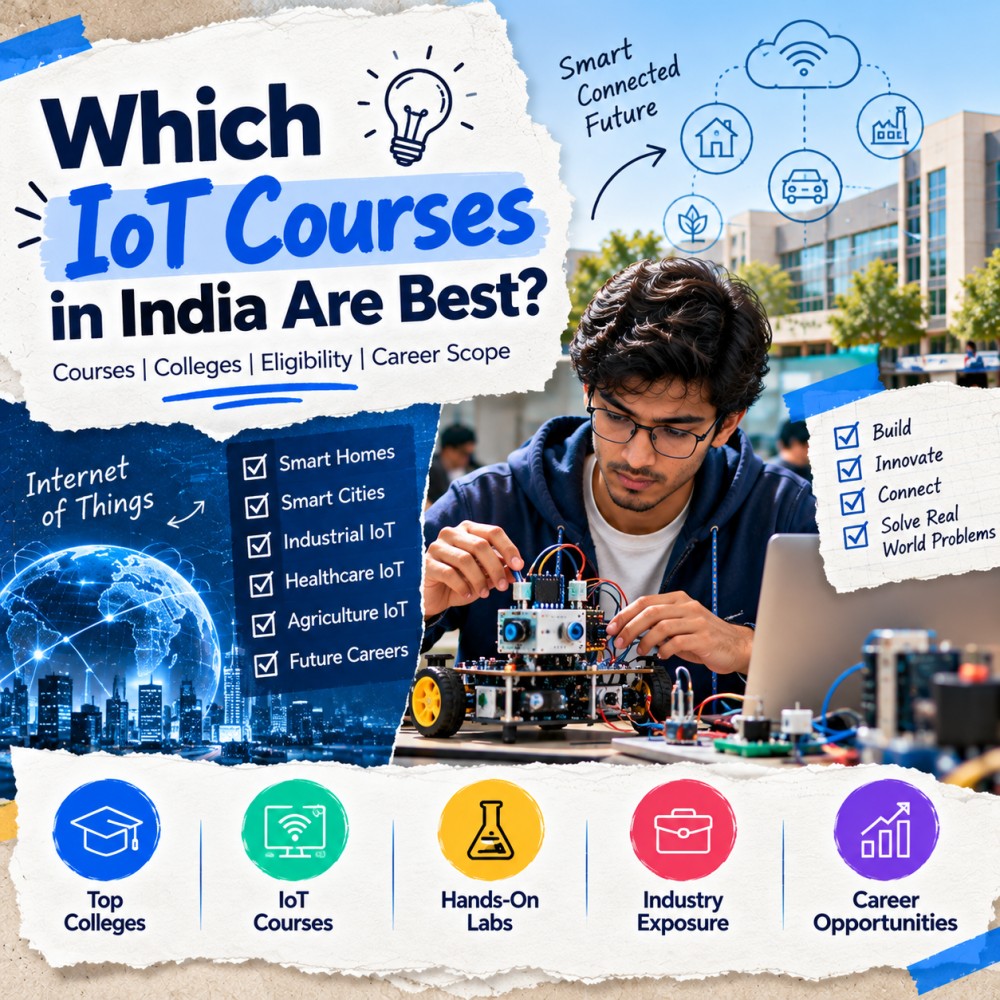
Which IoT Courses in India Are Best for Engineering Students?
Which IoT courses in India should you choose after Class 12? If you are interested in smart devices, automation, electronics and connected technologies, a Bachelor of Technology (B.Tech) programme with an Internet of Things (IoT) specialisation may be worth exploring.
The Internet of Things connects physical devices through sensors, software and networks so they can collect and exchange data. From smart homes to industrial automation, IoT is an important area of modern engineering.
Quick Answer: Which IoT Course Should You Choose?
The right IoT course depends on your educational qualification and career goals. After Class 12, students can explore B.Tech programmes in Computer Science Engineering with an IoT specialisation, IoT and Cyber Security, or Electronics and Communication Engineering with relevant IoT subjects.
For students looking at Delhi NCR, Echelon Institute of Technology, Faridabad, lists a B.Tech CSE specialisation in IoT and Cyber Security, including Blockchain Technology. The institute also highlights practical exposure to embedded systems, IoT training, engineering laboratories and industry projects.
Explore B.Tech programmes at Echelon Institute of Technology.
What Is the Internet of Things (IoT)?
The Internet of Things is a technology that allows physical devices to collect data, communicate over networks and interact with other systems. IoT solutions commonly combine sensors, microcontrollers, connectivity, software and data processing.
Examples of IoT applications include:
- Smart home devices and connected appliances.
- Wearable devices and remote health monitoring.
- Industrial automation and equipment monitoring.
- Smart agriculture and automated irrigation.
- Connected vehicles and traffic management.
- Energy monitoring and smart infrastructure.
Which Types of IoT Courses Are Available in India?
Students can choose from undergraduate degrees, postgraduate programmes and specialised certifications. Course availability and curriculum vary by institution.
1. B.Tech in Computer Science with IoT Specialisation
This pathway combines computer science fundamentals with connected devices, programming, networks and data-driven applications. Check the programme syllabus to understand how much emphasis it places on hardware and software.
2. B.Tech in IoT and Cyber Security
This interdisciplinary pathway combines connected-device technologies with cybersecurity concepts. It may suit students interested in building connected systems and understanding how to protect devices, networks and data.
3. B.Tech in Electronics and Communication Engineering
ECE provides a foundation in electronics, communication systems, circuits and embedded technologies. Depending on the curriculum, students may explore IoT through relevant subjects, electives and projects.
4. M.Tech and Postgraduate Technology Programmes
Graduates can investigate postgraduate options in related fields such as computer science, embedded systems and communication engineering. Confirm the specific course and eligibility requirements with each institution.
5. IoT Certifications and Short-Term Courses
Certifications can help students learn particular tools, programming languages, microcontrollers and IoT platforms. They can complement a degree but may not replace the requirements of a formal engineering qualification.
Why Consider Echelon Institute of Technology for IoT Studies?
Students searching for IoT courses in India can also consider engineering institutions in the Delhi NCR region. Echelon Institute of Technology (EIT) is located in Faridabad, Haryana, and is affiliated with Guru Gobind Singh Indraprastha University (GGSIPU), Delhi.
Echelon’s official B.Tech programme page lists IoT and Cyber Security, including Blockchain Technology, as a CSE specialisation. The institute also describes practical training in embedded systems and IoT, engineering laboratories, industry projects and internship opportunities.
What Should Students Explore at Echelon?
- Relevant engineering specialisation: Review the listed IoT and Cyber Security pathway and its current curriculum.
- Practical learning: Explore the institute’s stated laboratory facilities and embedded systems and IoT training.
- Interdisciplinary skills: Understand how IoT, networking, programming and security concepts can work together.
- Industry exposure: Ask about project work, internships, technical mentoring and opportunities to build practical solutions.
- Career preparation: Review the technical training and placement support available to students.
To make an informed decision, students should verify the current programme availability, admission criteria, fees, syllabus and placement information directly with the institution.
Visit Echelon’s official B.Tech page for programme information.
What Is the Eligibility for IoT Courses in India?
Eligibility depends on the degree, institution and applicable university admission rules.
- For B.Tech: Students generally need to pass Class 12 with the prescribed subjects and minimum marks. Physics and Mathematics requirements, accepted additional subjects and entrance or counselling rules depend on the programme.
- For M.Tech: A relevant bachelor’s degree is generally required, subject to the specific programme’s admission criteria.
- For certifications: Requirements vary. Introductory courses may welcome beginners, while advanced courses may expect programming or electronics knowledge.
For Echelon Institute of Technology, check the official B.Tech admissions page and current university admission guidance before applying. Do not rely solely on older admission articles for current eligibility or deadlines.
What Subjects Are Taught in an IoT Course?
Depending on the programme, an Internet of Things course may cover:
- Programming fundamentals, such as C/C++ or Python.
- Electronic circuits, sensors and actuators.
- Microcontrollers and embedded systems.
- Computer networks and wireless communication.
- IoT architecture and communication protocols.
- Cloud computing and data processing.
- Cybersecurity for connected devices.
- Prototyping, automation and project development.
When comparing IoT engineering colleges in India, check the published syllabus and practical components rather than assuming all programmes cover these subjects equally.
What Career Options Are Available After an IoT Course?
After developing the relevant technical skills and project experience, graduates may explore roles such as:
- IoT Developer
- Embedded Systems Engineer
- Firmware Developer
- IoT Solutions Engineer
- IoT Network Engineer
- Automation Engineer
- Connected-Device Systems Engineer
- IoT Security Analyst, with relevant security skills
Job titles and requirements differ by employer. Programming ability, networking fundamentals, electronics knowledge, practical projects and problem-solving skills can help students prepare for these roles.
How Should You Choose the Best IoT College in India?
Instead of choosing a college based only on a promotional ranking, compare the factors that affect your education and career preparation.
- Course structure: Does the curriculum match your interests in software, electronics, embedded systems or cybersecurity?
- Laboratory facilities: Are students able to practise with relevant equipment and build projects?
- Faculty support: Is academic guidance available for technical learning and project development?
- Industry exposure: Ask about internships, live projects, technical events and industry interaction.
- Affiliation and approvals: Verify the programme’s current status and applicable approvals.
- Fees and location: Compare total costs, commuting or accommodation requirements and available facilities.
- Placement information: Review recent, clearly reported data and understand which courses and students it covers.
Students can also explore these related resources:
- Why real-world learning matters for engineering students
- Understanding industry-integrated engineering education
- What to look for in advanced engineering laboratories
Frequently Asked Questions About IoT Courses in India
1. Which IoT courses are available in India after Class 12?
Students can explore B.Tech programmes in Computer Science Engineering with IoT specialisation, IoT and Cyber Security, or relevant Electronics and Communication Engineering pathways. Eligibility depends on the institution and programme.
2. Which college offers IoT and Cyber Security in Delhi NCR?
Echelon Institute of Technology in Faridabad lists a B.Tech CSE specialisation in IoT and Cyber Security, including Blockchain Technology. Students should verify the current programme details and admission requirements on the official website.
3. Is IoT a good specialisation for engineering students?
IoT can suit students interested in programming, electronics, sensors, connected devices and automation. The right choice depends on your interests, the curriculum and the practical skills you develop.
4. Is coding required for Internet of Things courses?
Most technical IoT pathways involve programming. Languages such as C/C++ and Python may be useful, depending on the course and its focus.
5. What is the eligibility for B.Tech IoT courses?
Applicants generally need to pass Class 12 with the subjects and marks specified by the institution and university. Check the latest admission rules before applying.
6. What jobs can students pursue after studying IoT?
Potential roles include IoT developer, embedded systems engineer, firmware developer, automation engineer and IoT solutions engineer. Employers may require additional skills or experience.
7. Does Echelon Institute of Technology provide practical IoT learning?
Echelon’s official B.Tech page describes embedded systems and IoT training, engineering laboratories, industry projects and internships. Contact the institute to confirm the current facilities and learning opportunities available to the selected programme.
Conclusion: Which IoT Course Should You Choose?
The best IoT course for you will depend on your academic background, technical interests and career goals. Compare the course syllabus, eligibility, practical facilities, industry exposure and total fees before making a decision.
For students exploring IoT courses in India and engineering options in Delhi NCR, Echelon Institute of Technology, Faridabad, is worth researching for its listed IoT and Cyber Security specialisation. Review the official programme information and speak with the admissions team to understand the latest details.
Explore more: B.Tech programmes at Echelon Institute of Technology.