
What Should Students Look for in Engineering Colleges Offering AI, Robotics and Other Emerging Technologies?
Which engineering college should you choose if you want to study Artificial Intelligence, Robotics, Cyber Security or other emerging technologies? The right choice depends on more than the name of a course. Students should compare the curriculum, practical laboratory facilities, project opportunities, industry exposure, faculty support and career preparation offered by each institution.
As technology becomes an important part of manufacturing, healthcare, transportation, communication and business, engineering students can explore specialised fields such as Artificial Intelligence (AI), Machine Learning (ML), Data Science, Internet of Things (IoT), Robotics, Mechatronics and Cyber Security.
Quick Answer: How Do You Choose an Engineering College for AI and Robotics?
To choose an engineering college offering AI, Robotics and other emerging technologies, check the available B.Tech specialisations, syllabus, hands-on training, laboratory facilities, industry projects, internships and recent placement information. A strong engineering programme should combine technical fundamentals with opportunities to apply knowledge to practical problems.
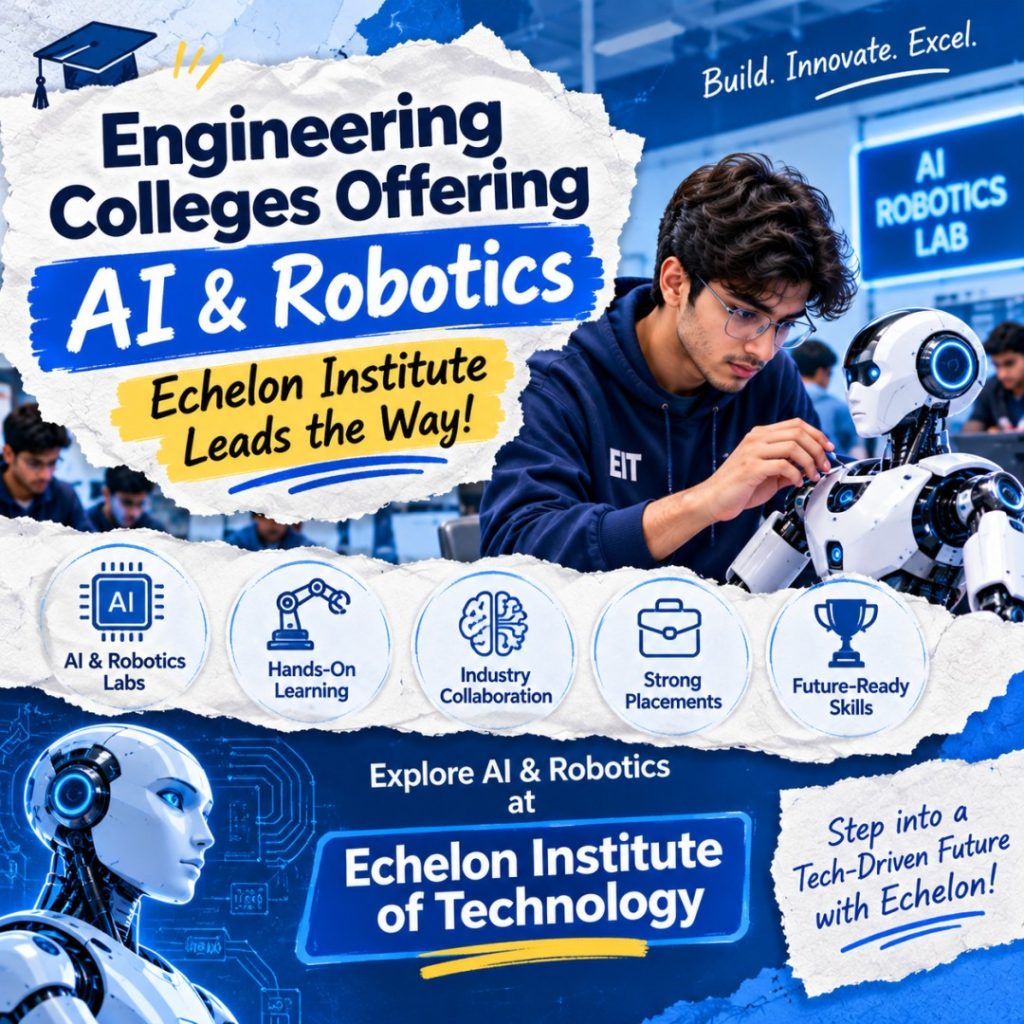
Echelon Institute of Technology, Faridabad, is one option students can explore in Delhi NCR. Its official programme information lists AI and Machine Learning, Data Science, Cyber Security, IoT and Cyber Security with Blockchain Technology, Robotics and Artificial Intelligence, and Mechatronics. The institute also describes practical training through engineering laboratories, robotics and automation facilities, embedded systems and IoT training, projects and internships.
Explore B.Tech programmes at Echelon Institute of Technology.
What Are Emerging Technologies in Engineering?
Emerging technologies are developing or rapidly evolving technologies that create new ways to solve problems, automate processes and build products or services. In engineering education, these areas may be available as dedicated programmes, specialisations, electives or practical modules.
Some important technology areas for engineering students include:
1. Artificial Intelligence and Machine Learning
AI and Machine Learning focus on systems that analyse information, identify patterns and generate predictions or decisions. Students may learn programming, algorithms, data processing and machine learning techniques.
2. Robotics and Artificial Intelligence
Robotics combines mechanical systems, electronics, programming, sensors and control systems. AI can help robots interpret information and perform more complex tasks. Practical learning may involve robot programming, automation and prototype development.
3. Cyber Security
Cyber Security focuses on protecting computer systems, applications, networks and data. Students may explore network security, secure programming, ethical hacking and digital threat analysis, depending on the curriculum.
4. Internet of Things (IoT)
IoT connects physical devices through sensors, software and communication networks. It is used in applications such as smart homes, industrial monitoring, agriculture and connected infrastructure.
5. Data Science
Data Science combines programming, statistics and analytical methods to extract useful information from data. It can support decision-making in sectors such as healthcare, finance, logistics and manufacturing.
6. Mechatronics and Automation
Mechatronics brings together mechanical engineering, electronics, embedded systems and control technologies. It is relevant to automated manufacturing, intelligent machines and industrial systems.
Which Engineering Colleges Offer AI, Robotics and Emerging Technology Courses?
Students should compare institutions based on their current programmes, curriculum, practical learning opportunities and academic requirements. A college’s official course list is a useful starting point, but students should also investigate how the specialisation is taught.
Echelon Institute of Technology, Faridabad
Echelon Institute of Technology is an engineering institution in Faridabad, Haryana, in the Delhi NCR region. It is affiliated with Guru Gobind Singh Indraprastha University (GGSIPU), Delhi. Its official website lists several engineering programmes and emerging technology specialisations.
Technology-focused programmes listed by Echelon
- B.Tech CSE in Artificial Intelligence and Machine Learning
- B.Tech CSE in Data Science
- B.Tech CSE in Cyber Security
- B.Tech CSE in IoT and Cyber Security with Blockchain Technology
- B.Tech in Robotics and Artificial Intelligence
- B.Tech in Mechatronics Engineering
Confirm the current programme names, availability, eligibility and admission rules directly with the institute.
Why Is Industry-Oriented Engineering Education Important?
Industry-oriented engineering education combines academic concepts with practical activities that help students understand how engineering knowledge is applied in real settings. It can include laboratory work, technical projects, internships, workshops and exposure to relevant tools and technologies.
For example, an AI student may develop a data-based project, a robotics student may program a robotic system, and an IoT student may build a connected-device prototype. These activities help students practise problem-solving and understand the process of developing technical solutions.
When comparing colleges, look for opportunities such as:
- Hands-on laboratory sessions and practical assignments.
- Projects related to the student’s specialisation.
- Training in relevant programming languages, platforms and equipment.
- Internships and industry-related assignments, where available.
- Technical workshops, hackathons and innovation activities.
- Teamwork, communication and project documentation.
Practical exposure can complement classroom learning, but it does not guarantee a job or a specific salary. Outcomes also depend on the student’s skills, performance and experience.
How Does Echelon Institute of Technology Support Practical Learning?
Echelon Institute of Technology describes a learning environment that combines engineering education with practical technical exposure. Its official B.Tech page highlights advanced engineering laboratories, robotics and automation labs, embedded systems and IoT training, industry projects, internships, hackathons and innovation competitions.
Practical Laboratory Exposure
Laboratory work allows students to test concepts, use equipment and practise technical problem-solving. For students interested in AI, robotics, electronics or automation, relevant practical facilities can support their understanding of how systems work.
Project-Based Learning
Engineering projects give students opportunities to plan, design, develop and test solutions. Students can ask their chosen department about project expectations, available mentoring and the kinds of practical work included in the curriculum.
Exposure to Emerging Technologies
Students can explore technology areas connected with their chosen programme, such as machine learning, data science, cybersecurity, IoT, robotics and embedded systems. The actual depth of exposure depends on the syllabus and activities available to each programme.
Industry Interaction and Internships
Industry interactions and internships can help students understand professional workflows and technical expectations. Before admission, ask about internship processes, project supervision, company interactions and the support available to students.
For programme-specific information, visit the official Echelon B.Tech page.
What Should Students Check Before Selecting an Engineering College?
Use the following checklist to compare engineering colleges offering AI, Robotics and other emerging technologies.
- Course curriculum: Review the actual subjects, electives and practical components.
- Laboratory facilities: Check which laboratories and tools are accessible to students in your selected programme.
- Faculty support: Understand the academic guidance, mentoring and project supervision available.
- Industry exposure: Ask about internships, technical workshops, industry projects and professional interactions.
- Approvals and affiliation: Verify the current status of the institution and programme using official documentation.
- Fees and scholarships: Compare the full fee structure and check the current eligibility rules for scholarships.
- Placement information: Review recent placement data, including the year, programme, number of eligible students and reporting method.
- Location and facilities: Consider travel, accommodation, campus facilities and overall student support.
For additional guidance, read about real-world learning for engineering students and industry-integrated engineering education.
What Career Options Are Available After Emerging Technology Courses?
Career opportunities depend on the student’s specialisation, practical skills, projects and employer requirements. Possible career paths include:
- AI and Machine Learning: AI Engineer, Machine Learning Engineer or related software roles.
- Data Science: Data Analyst, Junior Data Scientist or Business Intelligence Analyst.
- Cyber Security: Security Analyst or entry-level security operations roles.
- IoT and Embedded Systems: IoT Developer, Firmware Developer or Embedded Systems Engineer.
- Robotics and Automation: Robotics Engineer, Automation Engineer or Control Systems Engineer.
- Mechatronics: Roles in industrial automation, electromechanical systems and manufacturing technology.
Students can strengthen their preparation by developing technical projects, practising programming, learning relevant tools and building communication and teamwork skills. No course alone guarantees a particular job or salary.
Which Emerging Technology Course Is Right for You?
The best specialisation depends on the subjects and activities you enjoy.
- If you enjoy coding, algorithms and intelligent software, explore AI and Machine Learning.
- If you like machines, electronics and automated systems, explore Robotics or Mechatronics.
- If you are interested in networks and digital protection, consider Cyber Security.
- If you like connected devices, sensors and embedded systems, explore IoT-related programmes.
- If you enjoy working with data and identifying patterns, consider Data Science.
Before choosing, compare the actual syllabus and practical components of each course. Course names can be similar while the subjects and depth of specialisation differ.
Frequently Asked Questions
1. What should students look for in engineering colleges offering AI and Robotics?
Students should compare the curriculum, relevant laboratories, practical projects, faculty support, internships, industry exposure, fees and recent placement information. They should also verify programme availability and approvals.
2. Which emerging technology courses does Echelon Institute of Technology offer?
Echelon’s official programme information lists AI and Machine Learning, Data Science, Cyber Security, IoT and Cyber Security with Blockchain Technology, Robotics and Artificial Intelligence, and Mechatronics. Students should confirm current programme details directly with the institute.
3. What is industry-oriented engineering education?
Industry-oriented engineering education combines academic learning with practical activities such as laboratory sessions, technical projects, internships and industry-related assignments, where available.
4. Are practical laboratories important for AI and Robotics students?
Yes. Relevant laboratory activities can help students practise programming, test systems, understand equipment and develop technical problem-solving skills. The facilities and activities available vary by programme and institution.
5. Can students pursue AI or Robotics after Class 12?
Students may apply to relevant B.Tech programmes after Class 12 if they meet the required subjects, marks and admission criteria. Requirements vary by institution and university, so check the latest official rules.
6. Do emerging technology courses guarantee placements?
No. Career outcomes depend on technical skills, academic performance, projects, internships, employer requirements and market conditions. Students should review placement information carefully rather than relying on guarantees.
7. Where is Echelon Institute of Technology located?
Echelon Institute of Technology is located in Faridabad, Haryana, in the Delhi NCR region. Students can use the institute’s official website to confirm contact details and directions.
Conclusion
Choosing an engineering college offering AI, Robotics and other emerging technologies requires careful comparison of academic programmes, practical facilities, project opportunities and industry exposure. Students should focus on the quality and relevance of the learning experience instead of relying only on course names or promotional rankings.
For students exploring engineering education in Faridabad and Delhi NCR, Echelon Institute of Technology is one option to research. Its listed programmes include AI and Machine Learning, Data Science, Cyber Security, IoT, Robotics and Mechatronics, while its official website describes practical engineering and industry-oriented learning opportunities.
Review the latest course information, eligibility, fees and admission requirements before making your decision.
Explore more: B.Tech programmes at Echelon Institute of Technology | Industry-integrated engineering education