
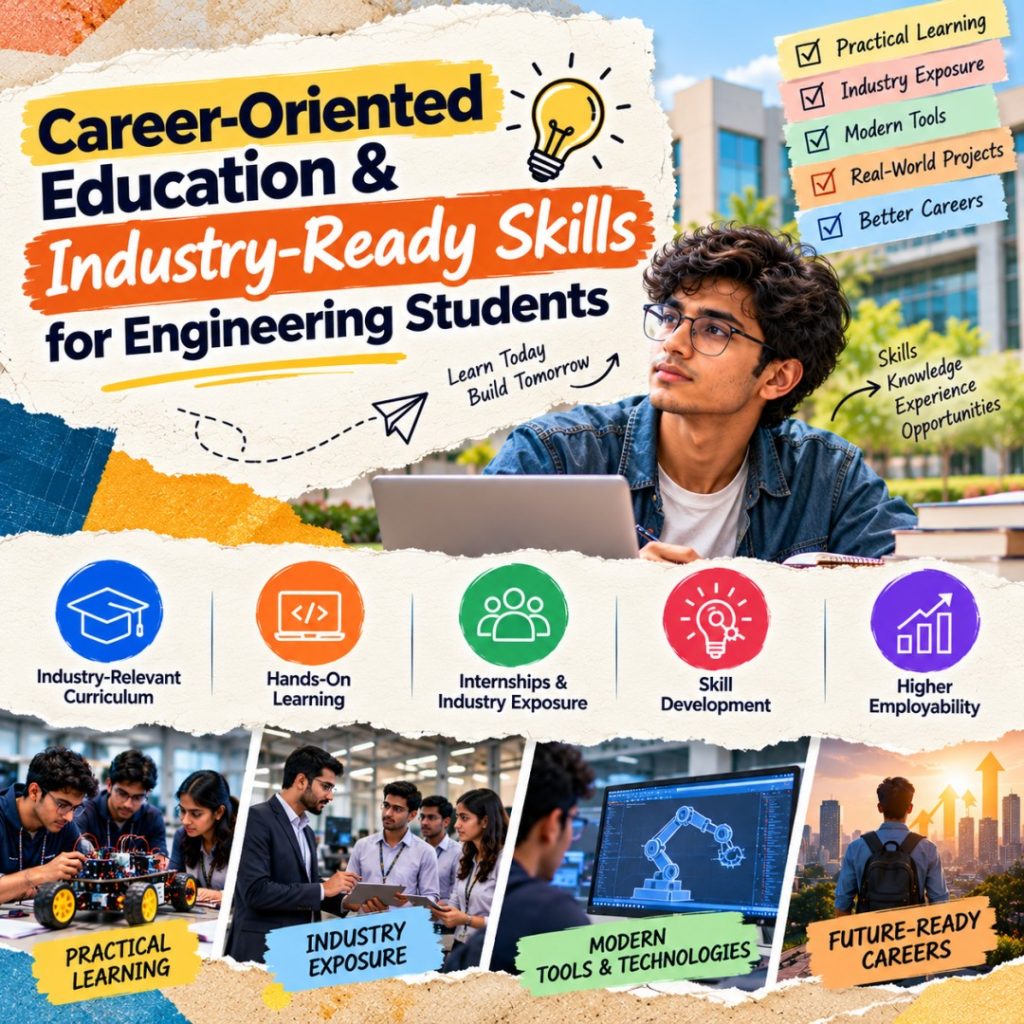
Engineering students need more than academic knowledge to prepare for professional careers. They also need practical experience, technical skills, communication abilities, problem-solving techniques, and the confidence to adapt to changing technologies. Career-oriented education connects classroom learning with these real-world requirements and helps students understand how their knowledge can be applied in professional settings.
What Is Career-Oriented Education for Engineering Students?
Career-oriented education is an approach to learning that connects academic subjects with the knowledge, skills, and experiences students may need in their chosen professions. It combines theoretical understanding with opportunities to solve problems, complete projects, practise technical skills, and explore career paths.
For engineering students, career-oriented education can include programming assignments, laboratory experiments, design projects, technical workshops, industrial visits, internships, aptitude development, and interview preparation. The activities available depend on the programme and institution.
The aim is not to replace academic fundamentals. Instead, career-oriented education helps students understand how those fundamentals can be used to develop solutions, evaluate problems, and contribute to professional projects.
Why Is Career-Oriented Education Important for Engineering Students?
Engineering involves applying scientific and mathematical concepts to practical challenges. Students who get opportunities to practise what they learn can better understand the relationship between theory and application.
Career-oriented learning can help students:
- Apply classroom knowledge to practical problems.
- Develop technical and analytical abilities.
- Improve communication and teamwork.
- Understand workplace expectations.
- Explore different engineering specialisations and career options.
- Build projects that demonstrate their learning and skills.
These experiences can support career preparation, although employment outcomes also depend on individual performance, qualifications, market conditions, and employer requirements.
What Industry-Ready Skills Should Engineering Students Learn?
Industry-ready skills are the technical and professional capabilities that help students perform tasks relevant to their chosen field. The exact requirements vary between engineering disciplines, employers, and job roles.
Which Technical Skills Help Engineering Students Prepare for Industry?
Students should prioritise technical skills that match their specialisation and career goals. For example:
- Computer Science: programming, data structures, software development, databases, and version control.
- Artificial Intelligence and Data Science: Python, data analysis, statistics, machine learning fundamentals, and responsible use of AI tools.
- Cybersecurity: networking fundamentals, operating systems, security principles, and safe security-lab practice.
- Mechanical and Mechatronics Engineering: CAD fundamentals, mechanical design, sensors, control systems, and automation concepts.
- Electronics and Communication: circuit analysis, embedded systems, digital electronics, and communication fundamentals.
- Civil Engineering: engineering drawing, surveying, construction methods, and relevant design software.
Students should build their foundations first and then practise the tools and technologies most relevant to their chosen roles.
Why Are Communication and Problem-Solving Skills Important for Engineering Students?
Engineers regularly explain ideas, document their work, collaborate with colleagues, and solve technical problems. Communication, teamwork, analytical thinking, time management, and project documentation can therefore complement technical expertise.
Students can develop these abilities through presentations, group assignments, technical reports, project demonstrations, peer collaboration, and participation in academic or technical events.
How Can Internships and Projects Help Students Become Industry-Ready?
Internships and practical projects allow students to apply concepts in realistic situations. A project may involve developing an application, testing a circuit, designing a mechanical component, analysing data, or creating an automation prototype.
These activities can help students practise planning, troubleshooting, teamwork, documentation, and presenting results. Internships may also help them understand professional workflows and workplace expectations.
Students should aim to document what they built, the problem they addressed, the tools they used, and what they learned. This makes it easier to explain their experience during interviews.
Which Future-Ready Skills Should Engineering Students Develop?
Future-ready skills help students continue learning and respond to changing technologies, tools, and workplace requirements. These skills are useful because no single technology or tool remains relevant in every role throughout a person’s career.
How Can Engineering Students Prepare for Emerging Technologies?
Students can develop a foundation in areas such as artificial intelligence, automation, cloud computing, cybersecurity, data analysis, and the Internet of Things, depending on their interests and specialisation.
They do not need to master every emerging technology. A more effective approach is to build strong fundamentals, choose a relevant area, complete practical projects, and keep updating their knowledge as the field develops.
Why Are Adaptability and Continuous Learning Important for Future Careers?
Technology and job requirements can change over time. Students who can learn new tools, evaluate information, accept feedback, and adapt their approach may be better equipped to navigate those changes.
Continuous learning can include online courses, technical documentation, professional workshops, certifications where relevant, project practice, and feedback from mentors or experienced professionals.
How Can Students Develop Innovation and Critical-Thinking Skills?
Innovation begins with identifying a problem, understanding its causes, exploring possible solutions, testing ideas, and learning from results. Engineering students can practise this process through prototypes, research assignments, hackathons, design challenges, and collaborative projects.
Critical thinking is equally important. Students should learn to assess evidence, compare alternatives, identify limitations, and explain why a particular solution is appropriate.
How Can Engineering Students Develop Industry-Ready and Future-Ready Skills During College?
Students can follow a practical development plan throughout their degree rather than waiting until their final semester.
- Strengthen academic fundamentals: Understand core subjects and identify areas that need additional practice.
- Choose relevant technical skills: Select tools and technologies that match the chosen engineering discipline.
- Complete practical projects: Apply classroom knowledge to small projects before progressing to more complex challenges.
- Seek industry exposure: Explore internships, industrial visits, workshops, expert sessions, and suitable project opportunities.
- Improve communication: Practise presentations, technical writing, teamwork, and explaining complex ideas clearly.
- Build a project portfolio: Document projects, contributions, results, and lessons learned.
- Prepare for recruitment: Practise aptitude tests, technical questions, resumes, and interviews where relevant.
- Keep learning: Review progress regularly and update skills according to career interests and industry developments.
How Can Students Choose an Engineering College That Supports Career Development?
Students comparing engineering colleges should examine more than the course title or campus facilities. They should look for evidence that the institution supports academic learning, practical application, skill development, and career preparation.
Useful questions to ask include:
- Does the programme provide laboratory work and project-based learning?
- Are students encouraged to participate in technical projects and competitions?
- Are internships, industrial visits, or industry interactions available?
- Does the institution provide communication and aptitude development?
- What career guidance and placement preparation are available?
- Are course details, approvals, affiliations, and placement information clearly documented?
Students should verify these details through official institutional information and ask about the opportunities available in their specific programme.
How Does Echelon Institute of Technology Support Skill Development for Engineering Students?
Echelon Institute of Technology, located in Faridabad, offers engineering and other professional programmes. Students exploring career-oriented education can review the institute’s official resources to understand its programmes, skill-development activities, and career support.
- Explore B.Tech programmes to review available engineering study options.
- Explore the Skill Development Department for information about technical and professional skill-development activities.
- Explore Training and Placement for information about career preparation and placement-related support.
- Review the placement process to understand the institute’s published placement-related procedures.
Prospective students should check the current course structure and available activities directly with the institute. The suitability of a programme depends on the student’s interests, learning needs, and career goals.
What Is the Difference Between Industry-Ready Skills and Future-Ready Skills?
Industry-ready skills help students perform tasks relevant to current roles and workplace expectations. Future-ready skills help them adapt as technologies, responsibilities, and career requirements evolve.
For example, a student may learn a programming language to develop software today while also developing problem-solving and continuous-learning habits that help them adapt to new tools in the future.
Both skill sets are complementary. Students benefit from learning the tools required for their intended roles while developing the ability to evaluate and learn new technologies over time.
Frequently Asked Questions About Career-Oriented Education and Engineering Skills
What is career-oriented education for engineering students?
Career-oriented education connects engineering concepts with practical learning, technical projects, professional skills, industry exposure, and career preparation. It helps students understand how academic knowledge can be applied in professional situations.
What industry-ready skills should engineering students learn?
Engineering students should develop technical skills relevant to their specialisation, along with problem-solving, communication, teamwork, project documentation, and professional skills. The specific technical skills depend on their intended career path.
Which future-ready skills should engineering students develop?
Useful future-ready skills include adaptability, critical thinking, digital literacy, continuous learning, communication, collaboration, and the ability to evaluate and apply emerging technologies responsibly.
How can engineering students gain practical experience during college?
Students can gain practical experience through laboratory sessions, academic projects, internships, technical workshops, industrial visits, competitions, and independent projects related to their chosen discipline.
Why are industry-ready and future-ready skills both important?
Industry-ready skills help students meet current workplace requirements, while future-ready skills help them adapt to changing technologies and responsibilities. Developing both can support long-term professional growth.
How can students choose a college that supports career-oriented education?
Students should review the curriculum, practical learning opportunities, laboratories, internships, industry interactions, skill-development activities, and career support. They should confirm current details with official college sources before making an admission decision.
How can Echelon Institute of Technology help students explore career development opportunities?
Students can review Echelon Institute of Technology’s official programme, skill-development, and placement pages to learn about available courses and career-related activities. They should contact the institute to confirm the latest opportunities for their selected programme.
Conclusion: How Can Engineering Students Prepare for Their Future Careers?
Career-oriented education helps engineering students connect academic knowledge with practical application and professional development. Industry-ready skills support current workplace requirements, while future-ready skills help students adapt to changing technologies and career opportunities.
Students can strengthen their preparation by building technical foundations, completing projects, seeking practical exposure, improving communication, and continuing to learn throughout college. When choosing an engineering institution, they should evaluate the quality of academic teaching alongside opportunities for practical learning and career development.
Exploring the official programme and skill-development information from Echelon Institute of Technology can help students assess whether its educational opportunities align with their individual goals.
Note: Course offerings, training activities, and placement-related opportunities may vary by programme and academic session. Verify current information with the institution.