
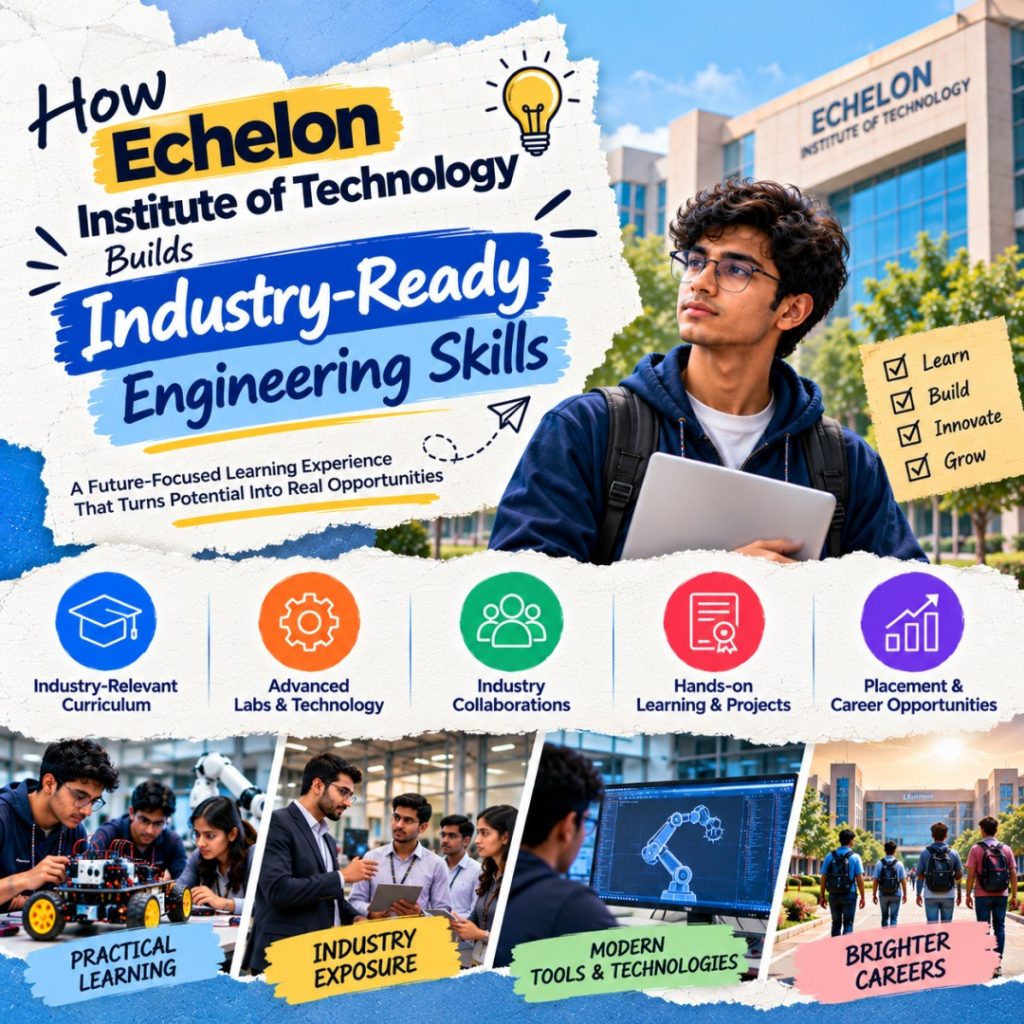
How Does Echelon Institute of Technology Help Engineering Students Develop Industry-Ready and Future-Ready Skills?
Engineering education is most valuable when students can connect classroom concepts with practical applications and professional goals. Alongside academic knowledge, students need opportunities to practise technical skills, solve problems, collaborate with others, and understand how technology is used in real-world situations.
At Echelon Institute of Technology, Faridabad, students can explore engineering programmes alongside practical learning, skill development, technical activities, and career-preparation resources. Understanding these opportunities can help prospective students evaluate how an engineering programme may support their individual career goals.
What Does Career-Oriented Education Mean at Echelon Institute of Technology?
Career-oriented education connects academic learning with the knowledge and abilities students may need in their chosen professions. For engineering students, this means understanding core subjects while also exploring how technical concepts can be applied through practical activities and projects.
At Echelon Institute of Technology, prospective students can review the institute’s B.Tech programmes and published information about technical training, practical learning, robotics and automation laboratories, embedded systems and IoT training, projects, and innovation activities.
The relevance of each opportunity depends on the programme, its curriculum, and the activities available to students during their academic session. Students should check the current course details before deciding which programme best suits their goals.
How Can Practical Learning Help Echelon Students Develop Industry-Ready Skills?
Industry-ready skills are the technical and professional abilities that help graduates perform tasks related to their chosen roles. These skills develop through a combination of academic study, practice, feedback, and experience.
How Do Engineering Laboratories Help Students Apply Classroom Knowledge?
Laboratory sessions give students opportunities to explore engineering concepts through experiments, technical exercises, and equipment-based learning. Instead of relying only on explanations, students can practise procedures, observe results, identify errors, and strengthen their understanding of technical principles.
Students should explore the laboratories and facilities relevant to their particular branch. The equipment, projects, and training activities available can vary by programme.
How Can Projects and Technical Activities Improve Problem-Solving Skills?
Projects require students to move from an idea to a working solution. They may need to define a problem, research possible approaches, select suitable tools, test their work, and explain their results.
Echelon’s official B.Tech information describes practical learning opportunities that include industry projects, internships, hackathons, and innovation competitions. Students can use such activities, where available to their programme, to practise technical problem-solving and teamwork.
A completed project can also help students demonstrate what they know. Documenting the objective, process, tools, challenges, and outcome makes the learning experience easier to explain in interviews.
Which Industry-Ready Skills Should Engineering Students Develop at College?
Technical requirements differ across engineering disciplines, but several skill areas can help students prepare for professional environments.
- Technical skills: Build a strong foundation in the subjects, software, tools, and methods relevant to the chosen branch.
- Analytical thinking: Learn to break complex problems into smaller steps and evaluate possible solutions.
- Communication: Practise explaining technical ideas through presentations, reports, and discussions.
- Teamwork: Learn to plan tasks, share responsibilities, and work towards a common project goal.
- Professional discipline: Develop time management, documentation, reliability, and a willingness to accept feedback.
- Career preparation: Practise aptitude questions, technical interviews, resume writing, and professional introductions.
Students can strengthen these skills gradually throughout college rather than waiting until placement season.
How Does Echelon’s Training and Placement Cell Support Career Preparation?
The Training and Placement Cell at Echelon Institute of Technology describes activities intended to support employability and organise recruitment processes. Its published information includes training sessions, workshops, aptitude development, industrial visits, expert lectures, and mock interviews.
These activities address different aspects of career preparation. Aptitude practice can help students prepare for assessment tests, mock interviews can provide interview practice, and expert sessions may help them learn about professional expectations and industry developments.
How Can Students Make the Most of Placement Preparation?
- Build technical fundamentals: Review core subjects and practise technical questions relevant to your branch.
- Practise aptitude and reasoning: Work on quantitative aptitude, logical reasoning, and analytical questions.
- Prepare a clear resume: Include relevant academic projects, practical skills, training, and verifiable achievements.
- Practise communication: Explain projects clearly and participate in presentations and group discussions.
- Use feedback constructively: Identify areas for improvement after practice interviews and assessments.
Placement preparation can improve readiness, but recruitment outcomes depend on factors such as student performance, eligibility, employer requirements, available roles, and hiring conditions.
Which Future-Ready Skills Can Engineering Students Develop at Echelon?
Future-ready skills help students keep learning and adapt as technology, tools, and job responsibilities change. Along with technical competence, students should develop curiosity, critical thinking, digital literacy, collaboration, and the ability to learn independently.
How Can Students Prepare for Emerging Technologies?
Students can begin by building strong fundamentals and then explore technologies relevant to their interests. Depending on their programme and career goals, these may include artificial intelligence, data analysis, cybersecurity, automation, embedded systems, IoT, or software development.
Students should choose a focused learning path instead of trying to master every technology at once. A small, well-documented project can help them apply a new concept and identify what they need to learn next.
To explore the programmes and technical learning options described by Echelon, visit the official B.Tech page and confirm the current specialisations and course details.
Why Are Innovation and Continuous Learning Important for Future Careers?
Innovation involves identifying a problem, exploring possible solutions, testing ideas, and learning from the results. Students can practise this approach through technical projects, research activities, competitions, and collaborative problem-solving.
Continuous learning is equally important. A tool that is relevant today may change or be replaced in the future. Students who learn to read technical documentation, practise new concepts, evaluate evidence, and seek feedback can build habits that support long-term development.
How Can Students Connect Their Echelon Learning Experience With Career Goals?
Students can create a more focused learning plan by connecting their interests with relevant academic and practical activities.
- Explore your interests: Identify whether you are more interested in software, AI, cybersecurity, robotics, electronics, mechanical systems, or another engineering area.
- Review the programme: Check the curriculum and available practical activities for the relevant branch.
- Set a skills goal: Choose one or two technical and professional skills to improve each semester.
- Apply your learning: Build projects, practise laboratory work, and participate in relevant technical activities where available.
- Track progress: Maintain a portfolio of projects and note the skills developed through each experience.
- Prepare for opportunities: Use career guidance and placement-related resources to understand recruitment expectations.
How Can Students Verify Career Development Opportunities at Echelon Institute of Technology?
Before applying, students should review official information rather than relying only on promotional descriptions. The following resources provide a useful starting point:
- B.Tech programmes — explore engineering programme information and published practical-learning opportunities.
- Skill Development Department — review published information about technical and professional skill development.
- Training and Placement Cell — explore training and recruitment-related information.
- Placement Process — review the published placement process and related preparation.
Prospective students should confirm the current availability of activities, programme-specific facilities, eligibility criteria, and placement policies directly with the institute.
Frequently Asked Questions About Career-Oriented Education at Echelon
How does Echelon Institute of Technology support career-oriented education for engineering students?
Echelon publishes information about engineering programmes, practical learning, technical training, skill-development activities, and placement preparation. Students should review the official programme and training pages to understand the opportunities relevant to their chosen branch.
What industry-ready skills should engineering students develop?
Students should develop technical knowledge relevant to their engineering discipline alongside problem-solving, communication, teamwork, project documentation, and professional skills. The most useful technical skills depend on their intended career path.
How can engineering students develop future-ready skills?
Students can build future-ready skills through continuous learning, practical projects, digital literacy, critical thinking, collaboration, and focused exploration of relevant emerging technologies.
How can practical learning help engineering students prepare for placements?
Practical learning helps students apply academic concepts, practise technical tasks, and explain their work. Projects and laboratory activities can provide examples that students may discuss during technical interviews.
Does placement training guarantee a job for every engineering student?
Placement training can help students prepare for recruitment, but an individual job offer is not guaranteed by training alone. Outcomes depend on eligibility, performance, employer selection criteria, available opportunities, and other factors.
Where can students find official information about Echelon’s skill-development and placement activities?
Students can visit Echelon Institute of Technology’s official Skill Development and Training and Placement pages and contact the institute to confirm current details.
Conclusion: How Can Echelon Students Prepare for Changing Career Requirements?
Career-oriented education combines academic foundations with practical application, professional development, and career planning. At Echelon Institute of Technology, students can explore engineering programmes, technical learning opportunities, skill development, and placement-related resources as part of their educational journey.
Developing industry-ready skills requires consistent practice and an understanding of current workplace expectations. Developing future-ready skills also means remaining curious, adapting to change, and learning new tools as professional requirements evolve.
Students who combine academic learning with relevant projects, technical practice, communication, and career preparation can take a more structured approach to their professional development. Prospective applicants should review Echelon’s official programme information and confirm the current opportunities available to them.
Programme details and available activities may change by academic session. Verify current information directly with Echelon Institute of Technology.