
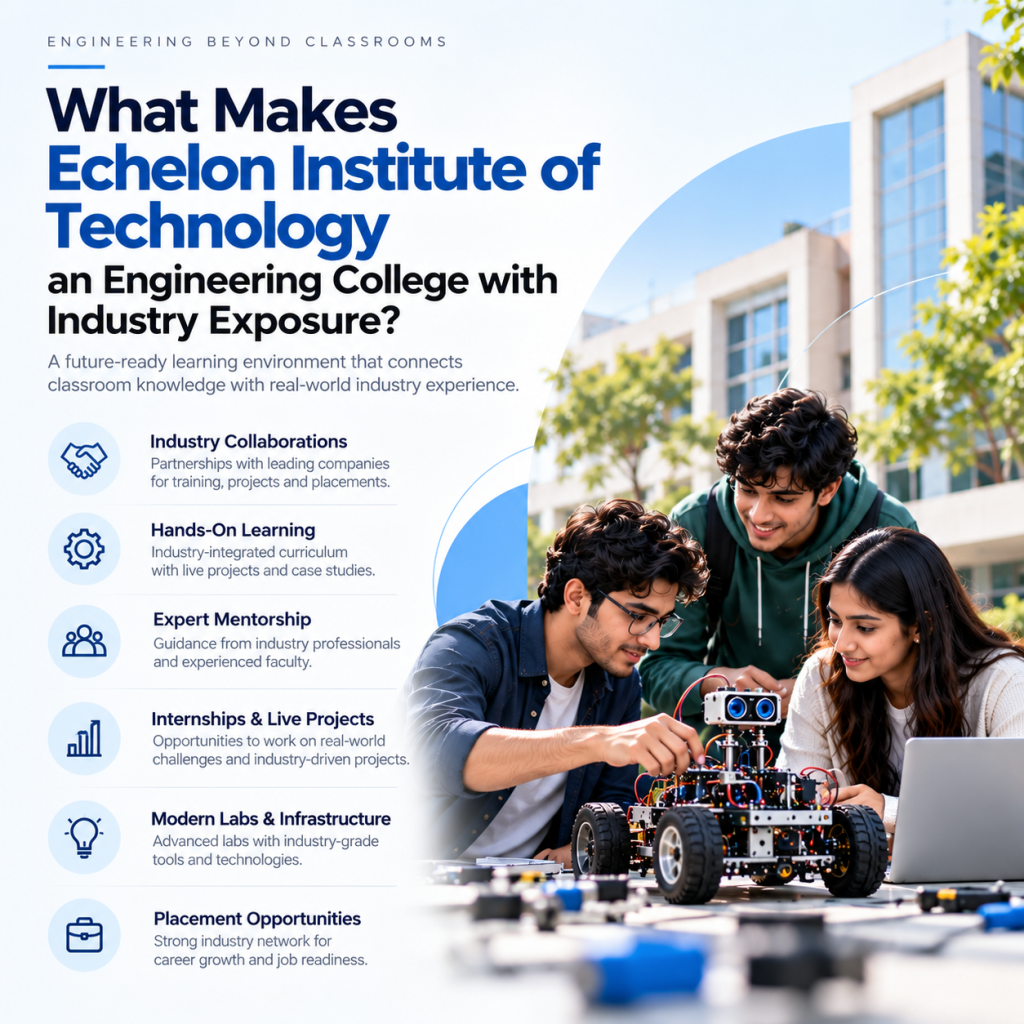
What Makes Echelon Institute of Technology an Engineering College with Industry Exposure?
Understand how industry exposure, experiential learning, practical projects, skill-based education and industry-oriented learning can help engineering students develop practical knowledge and career-ready capabilities.
What Is Industry Exposure for Engineering Students?
Industry exposure for engineering students means giving learners opportunities to understand how engineering concepts are applied in professional and real-world environments.
Classroom teaching provides students with theoretical foundations. However, engineering is an application-driven discipline, and students also need opportunities to experiment, design, build, test, analyse and solve problems.
Industry exposure can therefore include internships, industrial training, expert sessions, technical workshops, project-based learning, laboratory activities, technology certifications, industrial visits and industry-oriented projects.
The exact opportunities available to students can differ by programme, academic year and institution.
Why Is Industry Exposure Important for Engineering Students?
Engineering students eventually enter professional environments where they are expected to apply knowledge rather than simply recall concepts. Industry exposure can help students understand this difference while they are still in college.
Practical Application
Students can understand how theoretical concepts are applied to practical engineering problems.
Problem Solving
Real-world projects encourage students to analyse problems, test solutions and improve their approach.
Technical Skills
Practical exposure can help students become familiar with relevant tools, technologies and engineering workflows.
Teamwork
Collaborative projects can help develop communication, coordination and teamwork.
Career Awareness
Industry interaction can help students understand different engineering roles and career pathways.
Career Readiness
Practical learning can provide a foundation for internships, projects and entry-level professional opportunities.
What Is Experiential Learning in Engineering Colleges?
Experiential learning in engineering colleges means learning through practical experience and application rather than depending only on lectures and textbooks.
In engineering, this approach can include laboratory experiments, engineering projects, prototypes, simulations, coding applications, technical competitions, internships and industry-oriented assignments.
- Hands-on laboratory experiments
- Engineering design projects
- Software and technology projects
- Prototyping and product development
- Internships and industrial training
- Hackathons and technical competitions
- Simulation-based learning
- Industry workshops and expert sessions
How Does Real-World Learning Help Engineering Students?
Real-world learning for engineering students helps create a connection between classroom knowledge and practical engineering challenges.
For example, a computer science student may learn programming concepts and then apply them while developing a software project. Similarly, an electronics student may use theoretical concepts while working on circuits, embedded systems or automation projects.
The purpose is not to replace theoretical education. Instead, real-world learning complements theory by allowing students to understand how knowledge is applied.
What Is Industry-Integrated Education in Engineering Colleges?
Industry-integrated education in engineering colleges connects academic learning with professional practices, technologies and real-world applications.
Depending on the institution, this can involve industry experts, internships, project mentorship, technical workshops, Centres of Excellence, certifications, industrial visits and practical projects.
The strength of an industry-integrated approach should be evaluated by looking at how students actually experience these opportunities, rather than only looking at the number of organisations associated with a college.
How Does Echelon Institute of Technology Connect Engineering Education With Industry Exposure?
Echelon Institute of Technology (EIT) is an engineering institution in Faridabad that can be considered by students looking for practical and industry-oriented engineering education.
The institute’s learning environment includes academic instruction alongside laboratory-based learning, technology exposure, engineering projects and industry-oriented academic initiatives.
For students searching for an engineering college with industry exposure, the important consideration is how classroom learning is connected with practical activities, projects, laboratory work, internships, technical training and industry interaction.
Students should always check the latest official information for programme-specific internships, industry partnerships, certifications and practical learning opportunities because these may vary by programme and academic session.
What Should Students Look for in Colleges With Industry Partnerships?
Colleges with industry partnerships can provide valuable exposure, but students should understand what those partnerships actually offer.
- Does the partnership provide practical learning opportunities?
- Are students involved in industry-oriented projects?
- Are internships or industrial training opportunities available?
- Do industry professionals conduct workshops or expert sessions?
- Can students work with relevant technologies?
- Are certifications or specialised training available?
- Are these opportunities available across different engineering programmes?
Why Is Skill-Based Learning Important for Engineering Students?
Skill-based learning for engineering students focuses on the ability to apply knowledge through practical work.
Depending on the engineering discipline, relevant skills may include programming, data analysis, CAD, simulation, electronics, automation, artificial intelligence, cybersecurity, cloud technologies, communication and project management.
Skill development becomes more meaningful when students have regular opportunities to practise these skills through projects and applications.
What Is Career-Focused Education for Engineering Students?
Career-focused education for engineering students connects academic knowledge with skills and experiences that may be relevant to future professional roles.
This can include technical learning, practical projects, internships, industry interaction, communication development, career guidance and project-based assessment.
Such an approach can also help students understand the difference between choosing a degree and developing capabilities that can be applied after graduation.
How Can Engineering Students Develop Industry-Ready Skills?
Industry-ready skills for engineering students are developed gradually through learning, practice, feedback and repeated application.
| Skill Area | How Students Can Develop It |
|---|---|
| Technical Skills | Laboratory work, coding, engineering tools, simulations and technical projects. |
| Problem Solving | Design challenges, case studies, projects and real-world problem statements. |
| Communication | Presentations, technical documentation, group discussions and project demonstrations. |
| Teamwork | Collaborative engineering projects and multidisciplinary activities. |
| Project Management | Planning, execution, documentation, testing and project presentation. |
What Are Future-Ready Skills for Engineering Students?
Future-ready skills for engineering students include technical knowledge as well as transferable capabilities that help graduates adapt to changing technologies.
Emerging Technologies
Exposure to areas such as AI, machine learning, robotics, cloud computing, data and cybersecurity.
Analytical Thinking
Ability to break complex problems into manageable engineering challenges.
Adaptability
Willingness to learn new tools, technologies and professional practices.
Communication
Ability to communicate technical concepts clearly and effectively.
Collaboration
Ability to work effectively with people from different technical backgrounds.
Continuous Learning
Developing the habit of updating knowledge as technologies and industry requirements evolve.
What Does Engineering Education With Industry Exposure Look Like?
Engineering education with industry exposure should ideally connect several stages of student development.
- Learn: Build strong foundations in engineering concepts.
- Practise: Apply concepts through laboratories and practical exercises.
- Create: Develop projects, prototypes or software applications.
- Interact: Learn from industry experts and professional experiences.
- Experience: Participate in internships, industrial training or industry-oriented projects where available.
- Improve: Identify skill gaps and continuously develop technical and professional capabilities.
What Is the Difference Between Traditional and Industry-Integrated Engineering Education?
| Traditional Academic Focus | Industry-Integrated Approach |
|---|---|
| Classroom-based theoretical learning | Theory combined with practical application |
| Individual academic assignments | Projects and collaborative problem-solving |
| Limited professional interaction | Industry experts and professional exposure |
| Focus on completing academic requirements | Academic learning combined with skill development |
| Conceptual understanding | Conceptual understanding plus practical application |
These approaches are not necessarily alternatives. Strong engineering education needs both theoretical foundations and opportunities to apply those foundations.
How Does Industry Exposure Support Career Development?
Industry exposure can help students understand the relationship between their engineering degree and potential professional roles.
Through projects, internships and industry interaction, students may gain a better understanding of areas such as software development, artificial intelligence, cybersecurity, electronics, automation, data science, product development and other engineering domains.
- Internships and industrial training
- Industry-oriented projects
- Technical certifications
- Expert sessions
- Industrial visits
- Career mentoring
- Technical competitions
- Portfolio development
- Communication and interview preparation
How Should Students Choose an Engineering College With Industry Exposure?
Students should not evaluate industry exposure only by the number of company names associated with an institution. It is more useful to understand how students actually experience practical learning.
- Review the practical components of the engineering curriculum.
- Examine laboratory and project facilities.
- Check internship and industrial-training opportunities.
- Understand the nature of industry partnerships.
- Check whether industry professionals interact with students.
- Look for project-based and experiential learning.
- Review technology and certification opportunities.
- Compare opportunities across engineering branches.
Why Do Students Consider Echelon Institute of Technology for Industry-Oriented Engineering Education?
Echelon Institute of Technology can be considered by students who want to explore an engineering education model that combines academic foundations with practical and technology-oriented learning.
When evaluating EIT or any other engineering institution, students should consider the complete learning ecosystem — including laboratories, projects, internships, industry interactions, technical activities, faculty support and career development.
This broader evaluation gives students a better understanding of whether an institution’s approach matches their academic interests and long-term career goals.
Frequently Asked Questions About Industry Exposure for Engineering Students
What is industry exposure for engineering students?
Industry exposure for engineering students refers to opportunities that connect academic learning with practical and professional environments through projects, internships, workshops, training and industry interactions.
Which engineering college provides industry exposure?
Students should compare engineering colleges based on their practical learning model, internships, projects, laboratories, industry interactions and programme-specific opportunities. Echelon Institute of Technology is one institution students can consider when researching engineering education with industry exposure.
What makes Echelon Institute of Technology different?
Echelon Institute of Technology combines academic engineering education with practical learning, technology exposure, laboratory-based activities and industry-oriented academic initiatives. Students should review the latest official programme-specific information before making a decision.
Does Echelon Institute of Technology provide experiential learning?
Echelon Institute of Technology’s engineering learning environment includes practical and project-oriented components. Students should check the latest programme information to understand the specific experiential learning opportunities available in their chosen course.
What is experiential learning in engineering colleges?
Experiential learning is an approach where students learn by applying concepts through laboratories, projects, simulations, prototypes, internships, competitions and other practical activities.
Why is industry-integrated education important for engineering students?
Industry-integrated education can help students connect academic concepts with professional practices, technologies and real-world engineering applications.
What are industry-ready skills for engineering students?
Industry-ready skills can include technical knowledge, practical application, problem-solving, communication, teamwork, project management and familiarity with relevant technologies.
What are future-ready skills for engineering students?
Future-ready skills combine technical capabilities with adaptability, analytical thinking, communication, collaboration and continuous learning.
Why is skill-based learning important for engineering students?
Skill-based learning gives students opportunities to practise technical and professional capabilities and apply academic knowledge to practical situations.
What should students look for in colleges with industry partnerships?
Students should examine whether partnerships provide meaningful opportunities such as projects, internships, technical training, expert interactions, certifications or access to relevant technologies.
What is engineering education with industry exposure?
Engineering education with industry exposure combines academic concepts with practical learning, projects, internships, technology exposure, industry interaction and professional skill development.
How can industry exposure help engineering students?
Industry exposure can help engineering students understand practical applications, develop problem-solving abilities, improve teamwork and communication, and become more familiar with professional expectations.
Final Takeaway
The role of an engineering college is not limited to delivering theoretical knowledge. Students also need opportunities to apply concepts, work on projects, develop technical skills and understand professional environments.
Industry exposure for engineering students, experiential learning, real-world learning, industry-integrated education and skill-based learning can collectively contribute to a more practical engineering education.
Echelon Institute of Technology can be considered by students researching engineering colleges with practical and industry-oriented learning opportunities. Before choosing a college, students should compare programme structure, laboratories, internships, projects, industry interactions and other opportunities relevant to their chosen engineering discipline.