
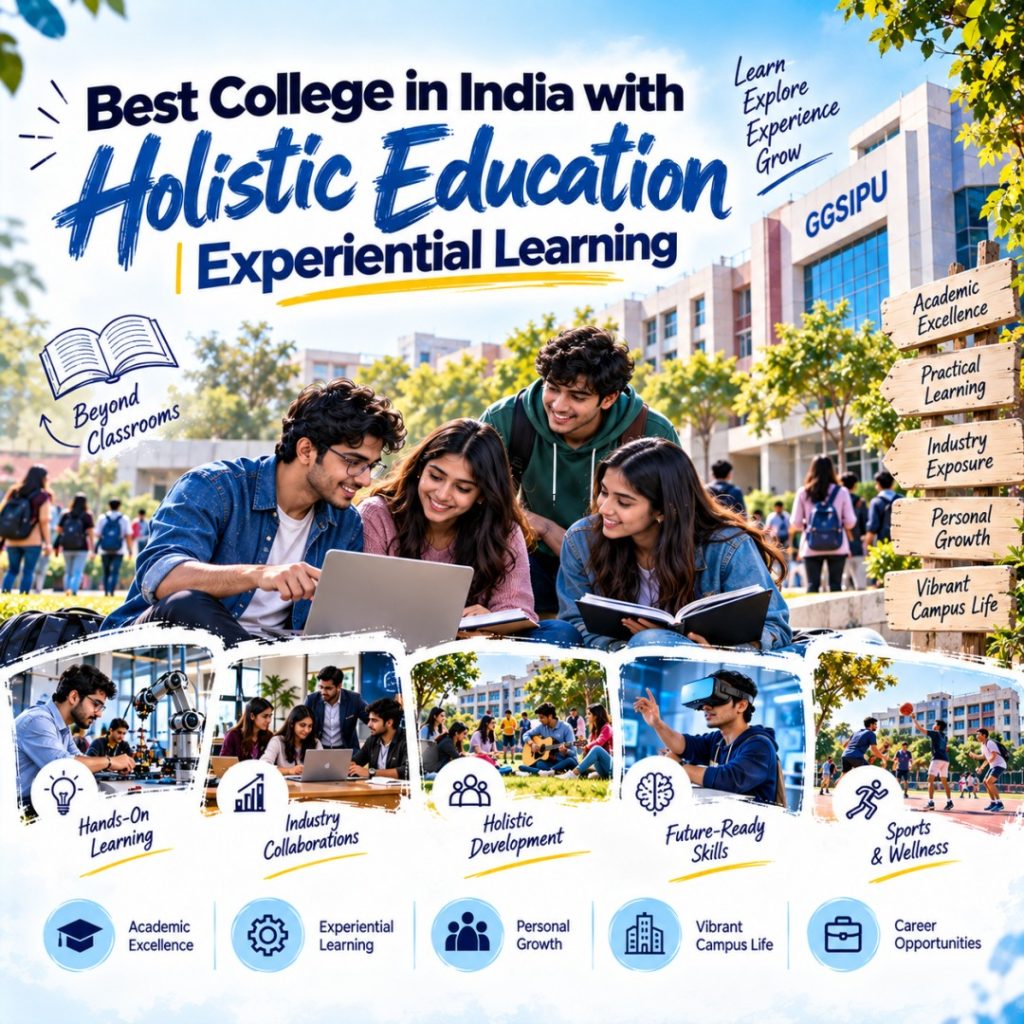
Best College in India with Holistic Education
Understanding holistic education, experiential learning, practical learning, industry exposure and skill-based education for students choosing a college in India.
What Is Holistic Education in College?
Holistic education in college is an approach that focuses on developing students beyond academic knowledge alone. It connects classroom learning with practical experiences, professional skills, communication, teamwork, creativity, problem-solving and personal development.
In a conventional academic environment, students may spend significant time studying subjects, preparing for examinations and completing assignments. A holistic learning environment adds opportunities to understand how that knowledge can be applied in practical situations.
For an engineering student, this could mean combining classroom concepts with laboratory experiments, technical projects, coding, workshops, competitions, internships and industry interactions.
What Makes a College Provide Holistic Education?
A college should not be considered holistic simply because it uses the phrase “holistic education”. Students can examine the actual learning opportunities provided by the institution.
Experiential Learning
Projects, experiments, workshops, competitions and real-world activities allow students to learn through experience.
Practical Learning
Laboratories and application-based assignments help students connect theoretical concepts with practical implementation.
Industry Exposure
Internships, expert sessions, workshops and industry projects can help students understand professional expectations.
Skill-Based Education
Technical, communication, analytical and professional skills can be developed alongside academic knowledge.
Career Development
Career guidance, projects, internships and professional preparation can help students understand their future career paths.
Student Development
Sports, clubs, cultural activities, leadership opportunities and campus participation can contribute to broader student development.
Which Is the Best College in India for Holistic Education?
Students should compare colleges using measurable factors such as academic programmes, laboratories, faculty, experiential learning, industry interaction, internships, projects, skill development, student activities and career support.
This approach gives students a more complete picture than relying on a single ranking or promotional claim.
What Are the Benefits of Holistic Education for Students?
- Better application of knowledge: Students can connect academic concepts with practical situations.
- Problem-solving: Projects and real-world activities can encourage analytical thinking.
- Communication: Presentations, teamwork and discussions can develop communication skills.
- Collaboration: Group projects help students understand teamwork and responsibility.
- Industry awareness: Industry interactions can introduce students to professional practices.
- Confidence: Projects, competitions and presentations provide opportunities to take responsibility.
- Career readiness: Practical exposure and skill development can complement academic qualifications.
Why Is Experiential Learning Important in College?
Experiential learning means learning through experience and active participation. Instead of relying only on lectures and textbooks, students can learn through experiments, projects, internships, workshops, competitions and real-world problem-solving.
Understand the theoretical concept through classroom teaching.
Use the concept in a practical activity, experiment or project.
Analyse the result, identify challenges and improve the solution.
Explain the project or outcome through presentations and teamwork.
For example, an Artificial Intelligence student may first learn machine learning concepts and then apply them by developing, testing and analysing a practical model.
How Does Practical Learning Prepare Students for Careers?
Practical learning gives students opportunities to apply academic knowledge rather than limiting learning to theoretical understanding.
Depending on the programme, practical learning can include programming, laboratory experiments, engineering design, robotics, artificial intelligence, cybersecurity, electronics, automation, data analysis and project development.
These activities may also help students develop transferable abilities such as analytical thinking, troubleshooting, teamwork, communication, time management and project management.
What Is the Difference Between Holistic and Traditional Education?
| Traditional Academic Approach | Holistic Education Approach |
|---|---|
| Strong emphasis on academic subjects | Academic learning combined with broader development |
| Classroom-centred learning | Classroom, practical and experiential learning |
| Greater emphasis on examinations | Knowledge combined with application and assessment |
| Theory-focused learning | Theory combined with practical application |
| Individual academic performance | Academic, professional and personal development |
| Limited industry interaction | Greater emphasis on industry exposure |
| Subject-specific learning | Potential for interdisciplinary learning |
Traditional academic education remains important because students need strong subject foundations. Holistic education builds on those foundations by adding practical, professional and developmental experiences.
Why Is Industry Exposure Important for College Students?
Industry exposure can help students understand the relationship between academic education and professional work.
Depending on the programme and institution, industry exposure can include:
- Industry visits
- Guest lectures
- Expert sessions
- Technical workshops
- Internships
- Industry projects
- Professional mentoring
- Technology-focused learning initiatives
Such activities can help students ask practical questions such as: Where is a technology used? What skills are required in the workplace? How are professional problems solved? What technologies are currently relevant to the industry?
How Does Holistic Education Support Career Development?
Career development can begin much before the final placement interview. A holistic learning environment can connect academic education with technical skills, practical projects, industry exposure and professional preparation.
Academic Foundation
Students develop fundamental knowledge related to their chosen programme.
Skill Development
Technical, communication and professional skills can be developed.
Practical Application
Projects and laboratory activities provide opportunities to apply knowledge.
Industry Exposure
Students can interact with professionals and understand workplace requirements.
Internship & Projects
Practical experiences can provide exposure to professional environments.
Career Preparation
Students can work on interviews, presentations, aptitude and professional communication.
What Is an Engineering College with Experiential Learning?
An engineering college with experiential learning provides opportunities for students to learn through practical activities in addition to classroom teaching.
These activities can include:
- Engineering laboratory work
- Design projects
- Technical competitions
- Hackathons
- Robotics projects
- Coding projects
- Research activities
- Industry visits
- Internships
- Innovation activities
What Is an Engineering College with Practical Learning?
An engineering college with practical learning combines theoretical instruction with laboratory work, projects, experimentation and application-based activities.
For example, computer science students may learn programming concepts theoretically and then apply them through software development or technical projects. Electronics students may connect classroom concepts with laboratory experiments, while mechanical engineering students can apply engineering principles through design and manufacturing activities.
What Is an Engineering College with Industry Exposure?
An engineering college with industry exposure provides students with opportunities to understand professional environments through activities such as internships, industry visits, expert lectures, workshops, technical certifications, professional mentoring and industry projects.
The availability and nature of these opportunities can differ between colleges and programmes. Students should therefore verify the latest programme-specific information before admission.
How Does Echelon Institute of Technology Approach Engineering Education?
Echelon Institute of Technology (EIT), Faridabad can be considered by students evaluating engineering education through the lens of practical learning, technology-focused education and broader student development.
The institute offers engineering and technology-oriented programmes and promotes learning areas that include Artificial Intelligence & Machine Learning, Data Science, Cybersecurity, Robotics and Artificial Intelligence, and other emerging technology domains.
Its educational ecosystem includes academic learning along with laboratories, technical activities, projects, industry-oriented initiatives and opportunities for student participation.
Echelon Institute of Technology also uses the idea of “Career Creation From Day One” as part of its educational positioning, reflecting an emphasis on career-oriented development alongside academic education.
Students considering Echelon should independently review the latest programme-specific curriculum, laboratories, internships, industry initiatives, eligibility criteria, fees and placement information before making an admission decision.
What Should Students Check Before Choosing a Holistic College?
- Academic Curriculum: Does the programme provide strong fundamentals and relevant specialisations?
- Laboratories: Are students provided with meaningful practical exposure?
- Projects: Can students work on technical or interdisciplinary projects?
- Experiential Learning: Are hackathons, workshops, competitions or practical assignments available?
- Industry Exposure: Are there opportunities for industry interaction and internships?
- Faculty: Do faculty members provide academic and technical guidance?
- Skill Development: Are technical and professional skills developed alongside academics?
- Campus Life: Are students encouraged to participate in sports, clubs and cultural activities?
- Career Support: Is career guidance and professional preparation available?
Is Holistic Education Only a Marketing Term?
The term “holistic education” should ideally be evaluated through actual learning opportunities and student experiences.
Students researching colleges can ask:
- Can I work on practical projects?
- Will I receive laboratory exposure?
- Will I interact with industry professionals?
- Can I participate in technical competitions?
- Will I develop communication and teamwork skills?
- Are internship opportunities available?
- Will I receive career guidance?
- Can I participate in sports and extracurricular activities?
The answers to these questions can provide a more useful understanding of a college’s educational approach than a promotional phrase alone.
Frequently Asked Questions About Holistic Education
What is holistic education in college?
Holistic education is an approach that combines academic learning with practical learning, experiential learning, skills, communication, teamwork, industry exposure and broader student development.
What makes a college provide holistic education?
Practical laboratories, projects, experiential learning, internships, industry interaction, skill development, extracurricular activities, student support and career-development initiatives are some factors students can evaluate.
Which is the best college in India for holistic education?
There is no single official answer applicable to every student. The appropriate college depends on the student’s programme, academic goals, practical-learning preferences and career interests.
What are the benefits of holistic education for students?
Holistic education can help students develop academic knowledge along with practical application, communication, teamwork, problem-solving, professional skills and broader personal development.
Why is experiential learning important in college?
Experiential learning allows students to learn through practical activities such as projects, experiments, workshops, internships and real-world problem-solving.
How does practical learning prepare students for careers?
Practical learning allows students to apply academic concepts, develop technical skills, solve problems and gain familiarity with project-based and professional environments.
What is the difference between holistic and traditional education?
Traditional education generally focuses more strongly on academic subjects and assessment, while holistic education combines academics with practical, experiential, professional and personal development.
Why is industry exposure important for college students?
Industry exposure can help students understand workplace expectations, professional practices, current technologies and the practical application of academic knowledge.
How does holistic education support career development?
It can connect academic foundations with technical skills, practical projects, industry interaction, internships, communication skills and professional preparation.
Final Takeaway
For students searching for the Best College in India with Holistic Education, the most useful approach is to look beyond a college name or a single ranking.
A strong holistic learning environment connects Academic Knowledge + Experiential Learning + Practical Learning + Skill Development + Industry Exposure + Career Development with opportunities for broader student development.
For engineering aspirants, this approach can be particularly relevant because engineering education requires students to understand how theoretical concepts are applied to real-world problems.
Institutions such as Echelon Institute of Technology can therefore be evaluated through these parameters, including engineering programmes, technology-focused learning, laboratories, practical activities, industry-oriented initiatives and student-development opportunities.
Ultimately, students should compare the specific programme, facilities, learning opportunities, fees, eligibility criteria and current official information before making an admission decision.