
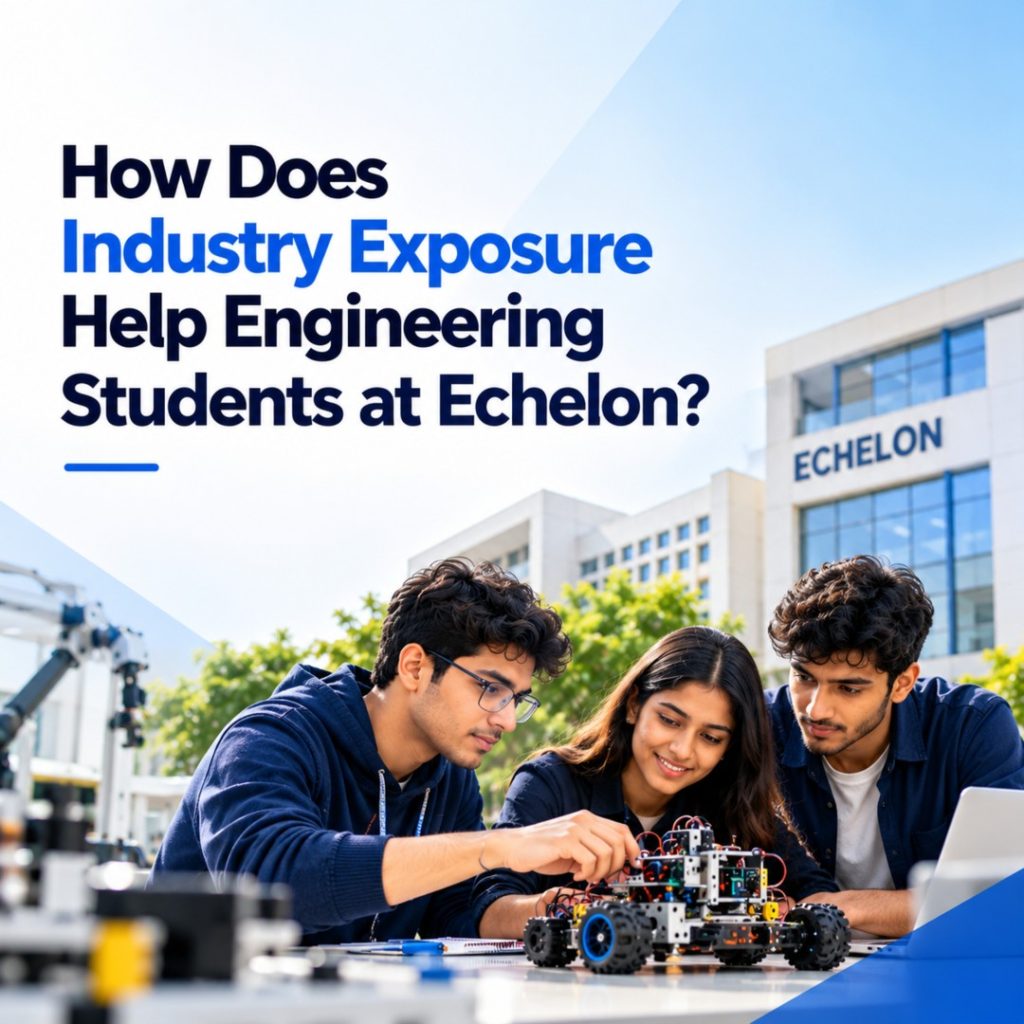
How Do Industry Exposure and Experiential Learning Help Engineering Students at Echelon Institute of Technology?
Engineering students learn more effectively when they can connect classroom concepts with practical applications. Laboratory experiments, technical projects, industrial visits, internships, and interaction with professionals can help them understand how engineering knowledge is used beyond textbooks.
For students exploring engineering colleges in Delhi NCR, industry exposure and experiential learning are important factors to consider. Echelon Institute of Technology, located in Faridabad, provides information about practical learning, technical activities, skill development, and career preparation that prospective students can review when evaluating their options.
What Is Industry Exposure for Engineering Students?
Industry exposure gives engineering students opportunities to understand how companies, engineering teams, and technical professionals work. It helps connect academic subjects with professional processes, technologies, workplace expectations, and practical challenges.
Depending on the institution and programme, industry exposure can include:
- Industrial visits to manufacturing plants, technology facilities, or other relevant workplaces.
- Internships and supervised practical experience.
- Guest lectures and sessions with industry professionals.
- Technical workshops and demonstrations.
- Projects based on practical engineering problems.
- Hackathons, innovation challenges, and technical competitions.
- Career guidance and industry-oriented training.
These activities can help students explore their interests, understand possible career paths, and identify the technical skills they may need to develop. The activities available will depend on the institution, department, and academic session.
Why Is Industry Exposure Important for Engineering Students?
Engineering education involves both understanding concepts and learning how to apply them. Industry exposure can help students see how engineering principles are used in professional environments and how technical decisions affect real projects.
How Does Industry Exposure Connect Theory With Practice?
Classroom teaching helps students understand concepts, formulas, systems, and design principles. Practical exposure gives them opportunities to observe how these concepts are applied to equipment, software, manufacturing processes, infrastructure, or technical services.
For example, a mechanical engineering student may learn about manufacturing processes in class and then explore how production equipment is used in an industrial setting. A Computer Science student may apply programming concepts through a software project or a technical workshop.
These experiences can improve understanding by helping students connect abstract ideas with practical applications.
How Can Industry Exposure Help Students Understand Workplace Expectations?
Professional engineering work often involves deadlines, teamwork, documentation, communication, safety procedures, and quality standards. Industry interactions can help students understand these expectations before they enter full-time employment.
Students can also learn to ask better questions about their chosen profession, the tools used in different roles, and the qualifications or experience required for particular career paths.
Does Industry Exposure Guarantee Better Placement Outcomes?
No. Industry exposure alone does not guarantee a job or placement. However, relevant internships, projects, technical practice, and professional communication can help students build experience they may discuss during recruitment.
Recruitment outcomes also depend on academic performance, individual skills, eligibility criteria, interview performance, employer requirements, and available job opportunities.
What Is Experiential Learning in Engineering Colleges?
Experiential learning is an educational approach in which students develop understanding through experience, practical activity, feedback, and reflection. Instead of only reading or listening to explanations, students actively apply concepts and learn from the results.
In engineering colleges, experiential learning may involve laboratory experiments, design assignments, programming exercises, prototypes, field observations, simulations, group projects, and technical problem-solving activities.
How Does Experiential Learning Help Engineering Students?
Experiential learning gives students opportunities to test their understanding and discover where they need more practice. It can also help them develop analytical thinking, creativity, collaboration, and confidence in applying technical knowledge.
For example, students working on a prototype may need to identify a problem, compare possible designs, select suitable components, test the prototype, and improve it based on the results. This process helps connect technical knowledge with decision-making and problem-solving.
How Is Experiential Learning Different From Classroom Learning?
Classroom learning often introduces concepts and explains the principles behind them. Experiential learning gives students opportunities to apply those concepts through activities and practical tasks.
Both approaches are important. Strong engineering education combines academic fundamentals with opportunities to practise, experiment, ask questions, and learn from mistakes.
How Does Real-World Learning Prepare Engineering Students for Careers?
Real-world learning connects academic study with practical situations that resemble challenges students may encounter in engineering, technology, manufacturing, construction, or other professional fields.
It can take place through projects, case studies, laboratory work, internships, simulations, industry visits, and collaborative assignments. The aim is to help students understand how knowledge can be applied to solve problems and develop workable solutions.
What Are Examples of Real-World Learning for Engineering Students?
- Software development: Designing and testing a small application to address a defined problem.
- Robotics and automation: Exploring sensors, controllers, mechanical components, and system behaviour through supervised practical work.
- Electronics: Building or testing circuits and analysing their performance.
- Mechanical engineering: Studying design, manufacturing processes, material behaviour, or mechanical systems.
- Civil engineering: Applying engineering principles to surveying, construction methods, materials, or structural concepts.
- Data and AI: Analysing a dataset, evaluating a model, or developing a small application using appropriate tools.
Projects should match the student’s academic level, programme, available facilities, and safety requirements. A well-documented small project can be a valuable learning experience when students understand the decisions behind their work.
What Is Industry-Integrated Education in Engineering Colleges?
Industry-integrated education connects academic learning with industry-relevant problems, tools, professional practices, or experiences. Depending on the programme, this may include industry-linked projects, expert sessions, internships, workshops, technical certifications, or collaboration with external organisations.
The purpose is to help students understand the relationship between engineering concepts and the needs of professional environments. The level of industry integration can vary considerably between institutions and programmes, so students should verify specific opportunities rather than relying on the term alone.
What Should Students Look for in Industry-Integrated Education?
Students comparing engineering colleges should investigate whether the programme provides:
- A curriculum that builds strong academic fundamentals.
- Practical laboratories and structured project work.
- Relevant internships or industry interaction opportunities.
- Workshops that introduce useful tools and technologies.
- Faculty guidance and feedback on practical assignments.
- Career preparation and professional skill development.
- Clear information about available activities and their eligibility requirements.
Students should also ask how frequently these opportunities are offered, which students can participate, and whether activities are part of the curriculum or optional enrichment.
How Can Echelon Institute of Technology Support Practical and Industry-Oriented Learning?
Echelon Institute of Technology is located in Faridabad, Delhi NCR. Students considering the institute can review its official programme and departmental information to understand the practical learning and career-development opportunities described for engineering students.
The institute’s published information includes engineering programmes, technical laboratories, practical activities, projects, skill-development resources, and placement-related support. Prospective students should confirm which activities are available to their selected programme and current academic session.
Where Can Students Explore Echelon’s Engineering Programmes?
Students can visit the official B.Tech programmes page to review programme information and explore the engineering branches available. This is a useful starting point for comparing academic interests with the subjects and specialisations offered.
How Can Students Learn About Skill Development and Career Preparation at Echelon?
The institute’s Skill Development Department provides information about its published skill-development activities. Students can also review the Training and Placement Cell for details about placement-related preparation and support.
These resources can help prospective students ask informed questions about technical training, practical experience, internships, and career preparation. Availability and participation requirements should be verified directly with the institute.
How Can Engineering Students Make the Most of Industry Exposure?
Students can take an active role in their learning by preparing for each opportunity and reflecting on what they learn.
- Set a learning objective: Decide what you want to understand before attending a workshop, visit, or expert session.
- Ask relevant questions: Explore the technologies, processes, skills, and challenges associated with the field.
- Connect the experience to coursework: Identify which academic concepts relate to what you observed or practised.
- Apply what you learn: Use the knowledge in a project, laboratory task, or independent exercise where appropriate.
- Document your progress: Record the skills developed, problems solved, and lessons learned.
- Seek feedback: Discuss your work with faculty members, mentors, or supervisors.
- Build gradually: Use each experience to identify the next skill or concept you want to learn.
Frequently Asked Questions About Industry Exposure and Experiential Learning
What is industry exposure for engineering students?
Industry exposure gives engineering students opportunities to understand professional environments through activities such as internships, industrial visits, expert sessions, workshops, and applied projects. It can help them connect academic concepts with workplace practices.
What is experiential learning in engineering colleges?
Experiential learning is an approach in which students develop understanding through practical activities, experience, feedback, and reflection. Engineering examples include laboratory experiments, prototypes, technical projects, simulations, and design assignments.
How does real-world learning help engineering students?
Real-world learning helps students apply academic concepts to practical problems, practise technical skills, and develop analytical thinking, teamwork, and communication. It can also help them explore possible career paths.
What is industry-integrated education in engineering colleges?
Industry-integrated education connects academic learning with industry-relevant problems, tools, and practices. Depending on the programme, it may include industry-linked projects, internships, workshops, expert sessions, and practical training.
How can students evaluate industry exposure at an engineering college?
Students should review the curriculum, laboratory facilities, project work, internship opportunities, industrial visits, expert interactions, and career support. They should ask which opportunities are available to their chosen programme and verify details through official sources.
How can students explore practical learning opportunities at Echelon Institute of Technology?
Students can review Echelon’s official B.Tech programmes, Skill Development Department, and Training and Placement pages. They should contact the institute to confirm the current practical activities and opportunities available for their selected programme.
Conclusion: Why Should Engineering Students Look Beyond Classroom Learning?
Industry exposure, experiential learning, real-world learning, and industry-integrated education can help engineering students connect academic knowledge with practical application. Each approach offers a different way to explore engineering concepts, practise skills, and understand professional environments.
When evaluating an engineering college, students should consider the quality of academic teaching alongside laboratories, project opportunities, industry interaction, internships, and career preparation. Echelon Institute of Technology’s official programme and training pages provide a starting point for exploring these aspects in Faridabad, Delhi NCR.
Students should verify current programme details and available activities directly with the institute before making an admission decision.